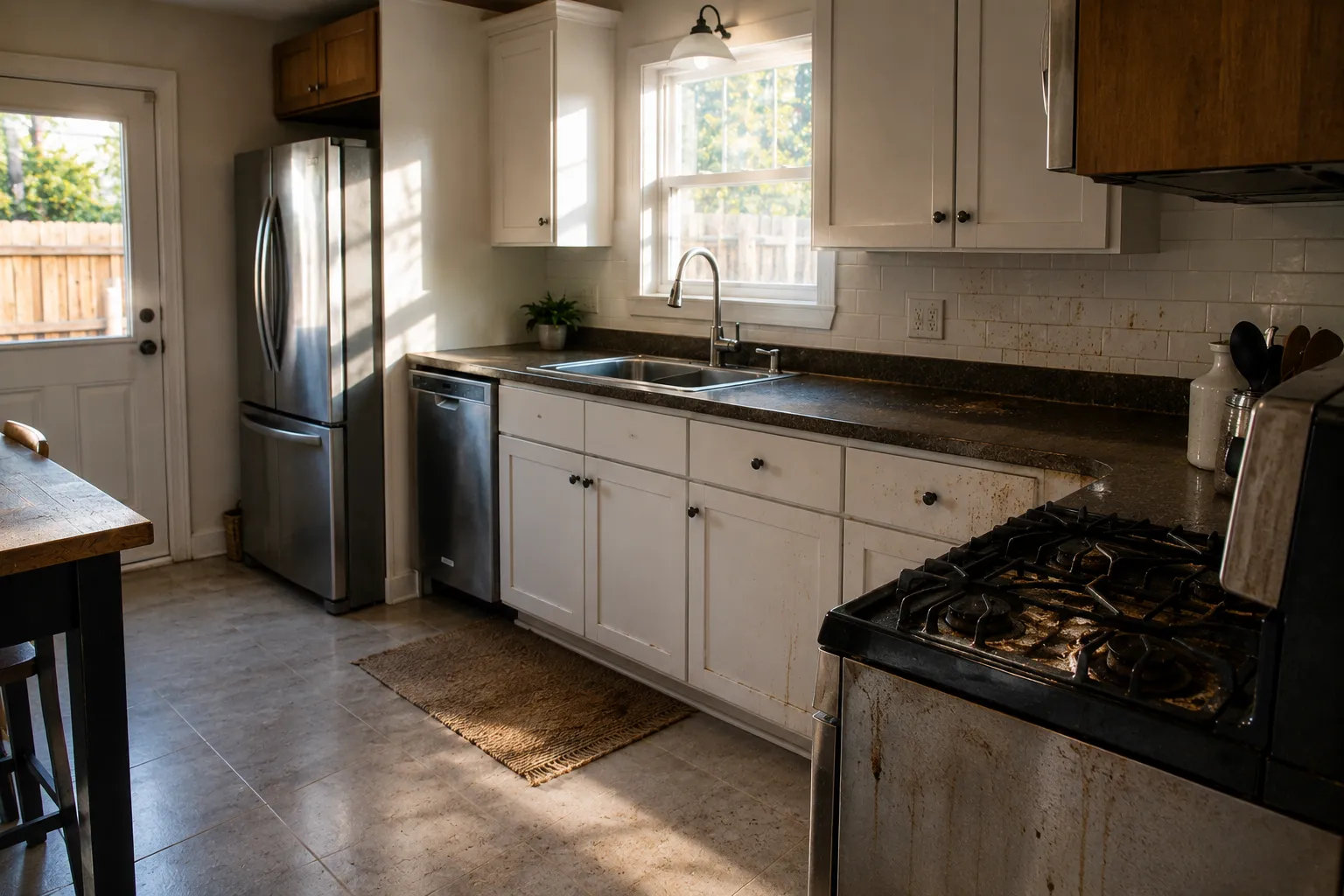
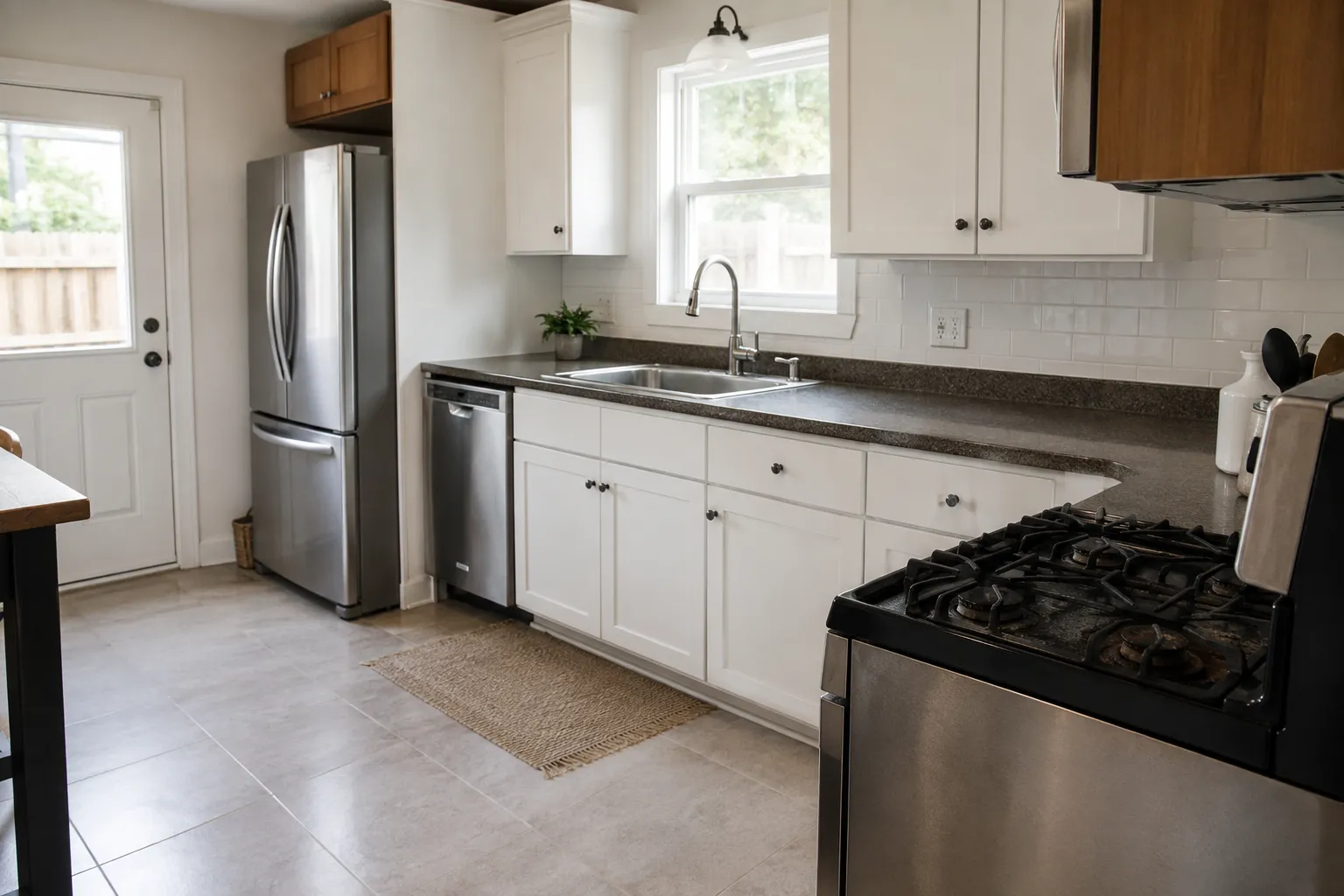
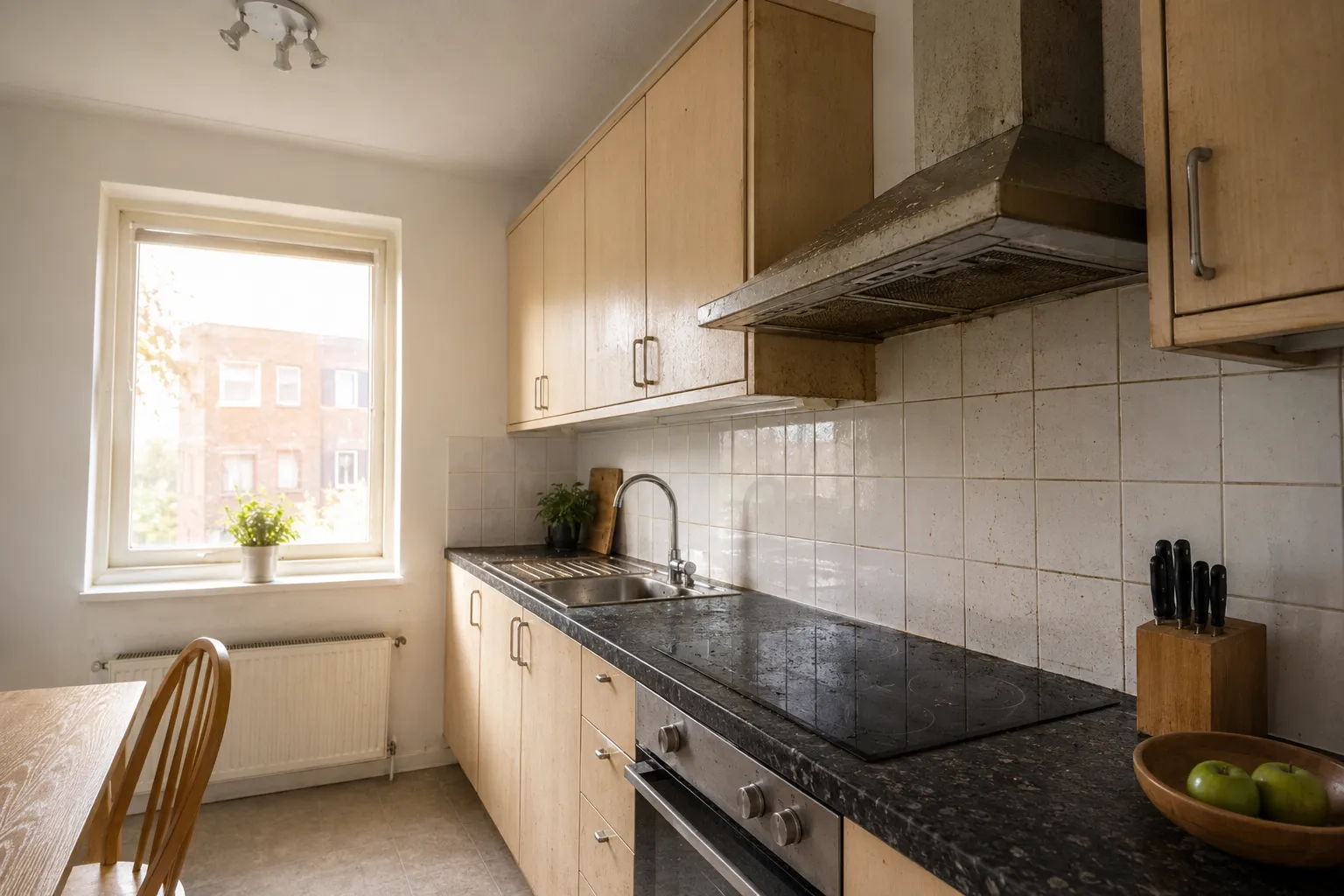
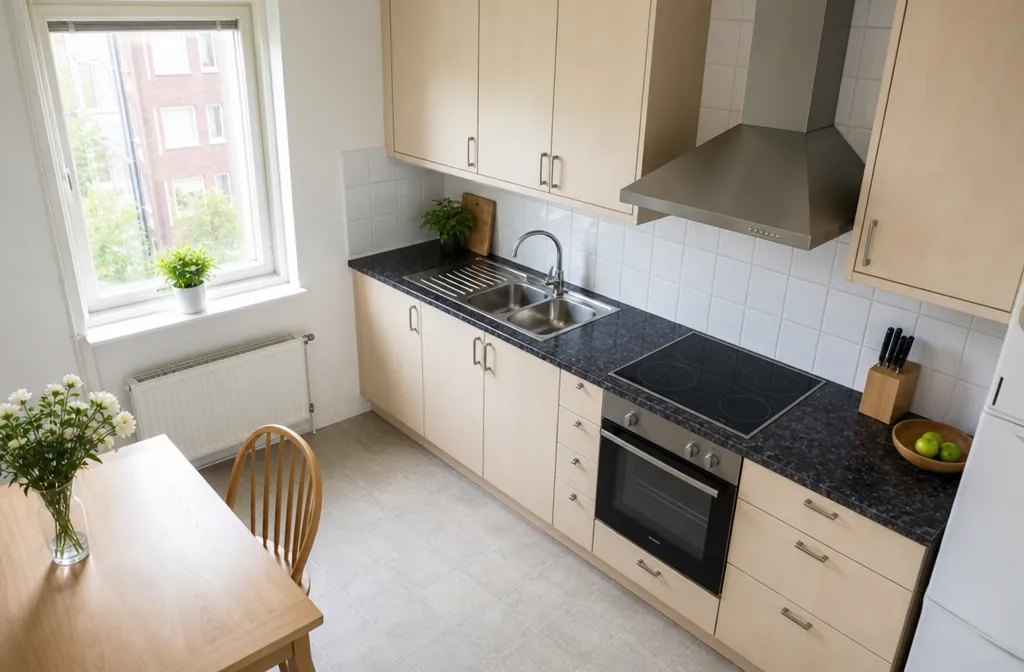
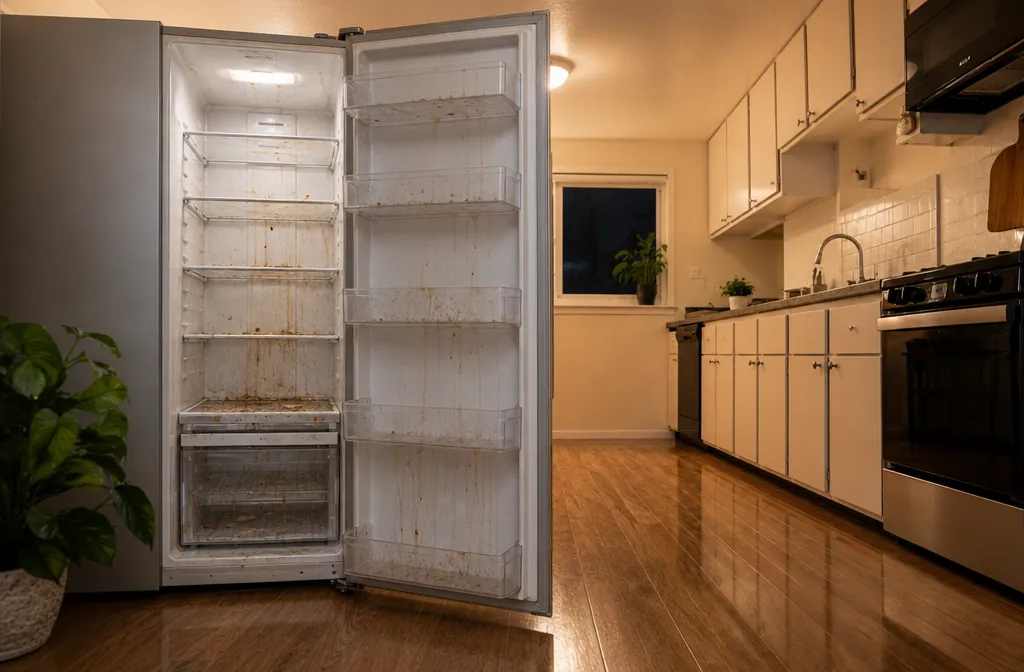
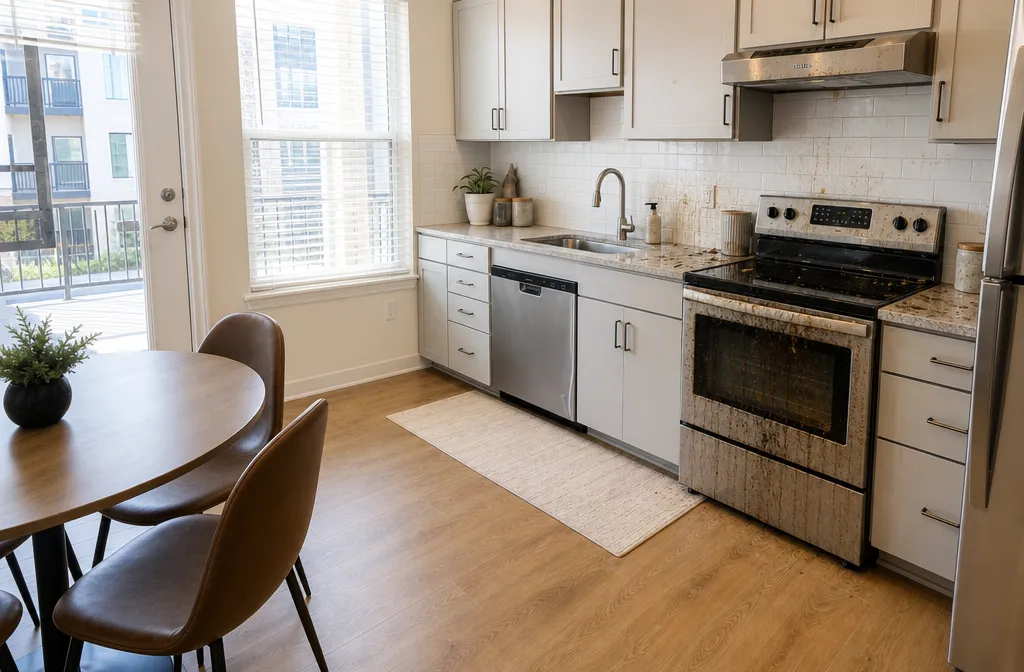
Why the Kitchen Requires a Separate Approach
The kitchen is the only room in an apartment where three types of dirt accumulate on surfaces simultaneously: grease, soot, and moisture, each requiring its own chemicals and techniques. Regular wet cleaning used in living rooms or bedrooms won’t work here: water and an all-purpose cleaner only spread the oily film rather than removing it. At profi-clean, we separate the kitchen into a distinct service not to charge more, but because the cleaning technology is fundamentally different — from the range of chemicals to the sequence of passes.
How Kitchen Cleaning Differs from Regular Cleaning
Composition of dirt: in a bedroom or living room, the main dirt is dust, pet hair, and occasional stains; in the kitchen, it’s thermally altered grease, burnt protein, and limescale from steam. A universal cleaning solution with a pH of 7-8 does not break down old grease — it leaves a thin, sticky film that collects new dust within a day. Alkaline agents (pH 10-14) dissolve grease at a molecular level, but only if the contact time of 3-5 minutes is maintained, not just wiped and rinsed off immediately. Wiping technique: on regular surfaces, a microfiber cloth with water is sufficient; in the kitchen, a two-phase pass is needed: first, an alkaline solution with the rough side of a sponge to soften the layer, then a clean microfiber cloth to remove the residue. Risk of damage: standard abrasive pastes scratch glossy MDF facades and stainless steel — in our practice, there was a case where a client ruined a cabinet door with a cleaning powder in a single cleaning session. Equipment: a vacuum cleaner with a HEPA filter is mandatory in the kitchen — it collects fine flour dust and particles of burnt food, which a regular bag vacuum cleaner would just circulate in the air. Result: after regular cleaning, the kitchen retains the smell of old grease, which is masked by air fresheners; after professional cleaning, the smell disappears on its own because the very breeding ground for bacteria has been removed. In our orders, clients most often notice the difference precisely by the smell — they return to us from kitchens that “smelled clean, but not fresh.”
Typical Mistakes When Cleaning the Kitchen Yourself
Washing the hood from the outside, but not the inside: owners wipe the hood’s casing but forget about the filters — within a month, the grease layer on the mesh reduces draft by 30-40%, and grease settles on the backsplash and ceiling. Using the same product for all surfaces: dish soap is not suitable for an artificial stone countertop — it leaves whitish streaks that cannot be removed by polishing. Hot water on glass-ceramic: sudden overheating from boiling water on a cold stove causes micro-cracks — within six months, a network of scratches appears on the surface where grease gets trapped. Neglecting hard-to-reach areas: under the refrigerator, behind the stove, and behind pull-out drawers, a significant amount of greasy dust accumulates over six months — it becomes a breeding ground for pantry moths and cockroaches. Drying wet surfaces with a cloth: after washing the backsplash and countertop, moisture remains in the joints and under the baseboard — within 3-4 months, black mold appears, which eats into the silicone sealant. Attempting to clean the oven with a household spray: supermarket sprays do not soften the burnt layer in 10-15 minutes — a cleaner at profi-clean has to remove the top layer with a paste and repeat the cycle twice, increasing the work time by 40 minutes. In my opinion, the most expensive mistake is cleaning the oven with an alkaline agent without protecting the heating element: the acid corrodes the contacts, making the heating uneven, and the stove starts to work under overload.
Which Kitchen Areas Are the Most Difficult to Clean Professionally
The back wall of the refrigerator and the condenser: a 2-3 mm layer of dust increases energy consumption by 15-20%, but access to the radiator is only possible after moving the appliance, and cleaning it with a vacuum cleaner without a brush attachment is risky — you can damage the thin fins. The interior of wall cabinets above the stove: aerosolized grease settles there, polymerizing into a hard yellow crust — it cannot be washed off with water, only with a solvent left on for 5-7 minutes, followed by mechanical removal with a plastic scraper. The joints between the countertop and the backsplash: silicone sealant absorbs grease and darkens within 6-8 months; whitening pastes don’t help — the only solution is to replace the sealant, but that’s a minor repair, not cleaning. The ventilation grille: if it’s not cleaned for 2-3 years, the grease layer reduces the duct cross-section by 50-60% — the kitchen stops ventilating, and odors linger in the apartment even after cooking. The bottom corners of MDF cabinet fronts: water seeps in when mopping the floor, causing the edge to swell, and within a year the cabinet front delaminates — our cleaners always wipe the bottom of cabinet fronts dry after wet cleaning, but at home this is forgotten. The space behind the dishwasher: crumbs and grease drips fall there, rot, and cause a musty smell — last October we had a case where the smell disappeared only after moving the dishwasher and cleaning the floor, even though the client had washed the entire kitchen twice.
Specifics of Kitchens in Almaty: What Adds Complexity
Hard water from the central water supply: the calcium salt content in Almaty water reaches 7-8 mg-eq/L — after drying, a white residue remains on the countertop that cannot be removed with a regular microfiber cloth, only with an acid-based cleaner containing citric or acetic acid. Humidity fluctuations: during the heating season (October-April), humidity in Almaty apartments drops to 20-25%, grease dries faster and forms a hard crust, while during the summer rains (May-June), humidity rises to 70-75% — on a porcelain stoneware backsplash, condensation mixes with grease and creates a sticky film that collects dust from open windows. Typical layout: in houses of the “1-464” and “1-464A” series (mass construction from the 1970s-80s in Almaty), kitchens are 6-8 m² with narrow walkways — the cleaner cannot work with full arm extension, having to wash cabinet fronts in sections, moving a chair every 10 minutes. Old-style range hoods: a third of Almaty kitchens have hoods without charcoal filters — grease is expelled directly into the ventilation shaft, settles on the inner walls, and after 2-3 years the shaft becomes so clogged that draft disappears, and odors from neighboring apartments come into yours. Cooking activity: according to our observations, Almaty families cook at home 5-6 times a week (tradition of family dinners), not 3-4 times as the average in Kazakhstan — the intensity of soiling is 30-40% higher, and preventive cleaning is needed every 2-3 weeks, not once a month. Specific ingredients: frequent use of turmeric, cumin, and paprika when frying — these spices produce a persistent yellow-orange pigment that penetrates the plastic of the hood and silicone seals, and can only be bleached with an oxygen bleach left on for 15 minutes. Moreover, if the pigment is not removed immediately, it becomes permanent — on hoods older than 3 years, we see indelible yellow stains that can only be masked by repainting the housing.
Main Types of Kitchen Contamination: Grease, Baked-on Grime, Soot
Each type of kitchen contamination requires its own chemicals, water temperature, and removal technique — a universal “all-purpose” cleaner only smears the grease and rubs the soot deeper into the surface pores.
Grease: Not Just a Stain, but a Polymer Film
Cooking fat is not a monolithic substance, but a mixture of triglycerides (fatty acids) with a molecular weight of up to 900 Da, which, when heated above 180 °C, partially polymerizes — turning into a sticky film with adhesion to plastic, stainless steel, and glass. In our orders in Almaty, we see that fat on range hoods and porcelain stoneware backsplashes accumulates in a layer up to 2-3 mm thick over 3-4 months of active cooking — and regular “Fairy” with a sponge doesn’t remove it, only smears it. Dissolving such a film requires alkaline compounds with a pH of 11-13 (e.g., Kiehl based on potassium hydroxide), which saponify triglycerides, turning them into water-soluble salts — a soap solution. On enameled surfaces (stoves, ovens), alkali works in 5-7 minutes, but on aluminum hood parts, it causes corrosion — for these, we use neutral gel removers with coconut-based surfactants that do not damage the metal. Moreover, fat that is not washed off within 24 hours after cooking begins to oxidize with atmospheric oxygen — its adhesion to the surface increases 2-3 times, and removal requires mechanical treatment with a nylon-bristle brush. Our practical advice: if you plan a deep clean once a month rather than once a quarter, the fat on the hood can be cleaned in 15 minutes without abrasives — delay turns it into baked-on grime.
Baked-on Grease: Thermally Modified Fat That Scratches
Baked-on grease is fat that has undergone pyrolysis at temperatures of 250-350 °C (on burners, in the oven, on the grill), resulting in the formation of amorphous carbon with a Mohs hardness of 1.5-2 — it is softer than glass (5.5) but harder than Teflon (0.3-0.4), so when you try to scrape it off with a metal sponge, you are guaranteed to leave micro-scratches on enamel and ceramic. In Almaty apartments with gas stoves (about 60% of the city’s housing stock), baked-on grease forms faster due to incomplete combustion of natural gas with impurities — soot settles on the bottom of pans and burner grates in a sooty layer that embeds into the pores of cast iron. To dissolve baked-on grease, we use a two-stage protocol: first, apply an alkaline gel for 20-30 minutes to soften the carbon crust, then rinse with a steam generator at a pressure of 5-8 bar — steam penetrates micro-cracks and pushes out residues without friction. On Teflon coatings (non-stick pans, baking molds), alkali is contraindicated — it destroys the fluoropolymer film in 2-3 applications, so for these, we have a separate protocol with biodegradable enzyme-based Sodasan products, which break down baked-on grease in 40-60 minutes at 50 °C. Before scrubbing baked-on grease with an abrasive, check the coating type: on stainless steel, a cerium oxide-based paste is acceptable; on enamel, only a soft nylon brush — otherwise, the cost of surface restoration will equal the cleaning cost.
Soot: Carbon Deposits That “Bake” onto Vertical Surfaces
Soot is a suspension of solid carbon particles sized 0.1-10 microns, formed during incomplete combustion of gas, oil, or food (especially when frying over an open flame or in a wok/kazan) and settling on vertical surfaces — walls, cabinet fronts, ceilings — as a gray-black deposit with a sticky texture due to the condensation of volatile organic compounds (VOCs). In Almaty, where private houses and first-floor apartments often use kazans for pilaf, soot on the kitchen ceiling and upper cabinets accumulates over 2-3 months of cooking and cannot be washed off with water — carbon particles are hydrophobic and “bake” onto the oil film from fat, forming a composite coating that can only be removed with solvents (isopropyl alcohol, white spirit) or steam with added surfactants. Our practice shows that soot on glossy MDF facades can be cleaned without traces using a microfiber cloth soaked in an alcohol solution (30% isopropanol, 70% water), but on matte surfaces (painted drywall, textured wallpaper), alcohol leaves streaks — for these, we use a neutral car interior cleaning shampoo followed by steam treatment at 130 °C. If soot is not removed for longer than 6 months, it polymerizes to the point of embedding into the paint coating, and the only solution is repainting the walls. We recommend checking the condition of the hood once a month: if a black deposit appears on its grille, soot is already settling on kitchen facades — call for cleaning before the soot penetrates the pores.
Combined Stains: Grease + Soot + Moisture (The Most Challenging Scenario)
In the washing area and around the dishwasher, grease mixes with soot and moisture (condensation from steam, water splashes), forming a sticky emulsion that hardens on silicone seals, countertop joints, and cabinet legs. In this environment, at temperatures of 20-30 °C and humidity above 70%, mold fungi Aspergillus and Penicillium, which feed on fatty acids and release mycotoxins, begin to multiply within 48 hours. In Almaty, where humidity during the off-season (autumn-spring) reaches 75-80%, we detect black mold at the joints of the countertop with the sink in every third order — grease serves as a nutrient medium for it, and soot masks the initial outbreaks. Removing such buildup with detergents is useless: first, you need to mechanically remove the emulsion with a Teflon-coated scraper, then treat the joints with a fungicidal compound (e.g., based on quaternary ammonium compounds) for 15-20 minutes, and only then apply a degreaser followed by steam rinsing. On wooden countertops (solid wood, plywood), combined contamination penetrates pores to a depth of up to 1 mm within 3-4 months — after removal, sanding and oil impregnation will be required. We recommend wiping the joints of the sink and countertop with a dry microfiber cloth once a month to prevent moisture from mixing with grease — this prevents 90% of mold problems.
Typical mistakes when trying to remove contaminants yourself
The most common mistake is using abrasive powders (“Comet,” baking soda) on glossy and chrome surfaces: abrasive particles (calcite, quartz) are harder than chrome (5 vs. 5.5 on the Mohs scale), and after three or four cleanings, the chrome coating of the faucet or hood grille becomes matte and then begins to corrode. The second most common is using chlorine-containing bleaches (“Belizna”) on stainless steel: chlorine reacts with iron in the alloy, causing pitting corrosion, which appears as dark spots that cannot be polished out. The third is washing the hood and filters with hot water and soap immediately after cooking: a sharp temperature change (the filter is heated to 60-80 °C, tap water is 40-50 °C) deforms the aluminum frames, and the filter no longer fits tightly. In Almaty, we also encounter attempts to clean soot from the ceiling with vinegar — acetic acid (5-9%) dissolves lime whitewash, leaving rusty stains that cannot be painted over without primer. Our recommendation: to remove grease from the hood, use dishwashing gel in a 1:5 ratio with warm water (not hot!), apply for 10 minutes, and rinse with a damp microfiber cloth — this is gentler than any powders and safer for aluminum.
What products and tools are used for the kitchen
In the kitchen, improperly chosen chemicals or tools not only leave streaks — they penetrate grease, damage the backsplash coating, and shorten the lifespan of appliances. At profi-clean, we select formulations based on the specific type of contamination and material, rather than cleaning the entire kitchen with one gel.
Professional chemicals: alkali vs. acid
For greasy surfaces (stove, hood, cabinets above the cooktop), we use alkaline concentrates with a pH of 11–13 — they break down stubborn grease into molecules without requiring repeated scrubbing. To remove limescale from chrome faucets and glass-ceramic surfaces, we use acidic products based on citric or sulfamic acid. In between are neutral formulations for wooden cabinets and artificial stone countertops: alkali eats away the protective oil, acid damages the polish. In Almaty, the water is hard (up to 8 mg-eq/L), so limescale appears on faucets within 2–3 weeks — we treat them with acid during every regular cleaning, not once a quarter.
Tools with a HEPA filter: why a vacuum cleaner is more important than a cloth
A vacuum cleaner with an H13 HEPA filter captures 99.97% of particles up to 0.3 microns — flour, sugar dust, and micro-particles of burnt oil settle in the filter rather than floating around the kitchen. After dry cleaning, we go over surfaces with a steam generator equipped with a scraper attachment: 150°C steam softens grease on the hood and grilles, after which it is removed with a microfiber cloth without abrasives. For tile joints and gaps between the countertop and wall, we use a set of crevice tools — this is where sticky residue accumulates, which a regular cloth only smears around.
Common mistakes when choosing products and their consequences
- Vinegar or lemon juice for marble and granite: acid eats away the polish, the countertop becomes matte and absorbs grease.
- Abrasive powders for enamel stovetops: scratches collect burnt-on residue, which can then only be removed with alkali and prolonged soaking.
- Dish soap on MDF cabinet fronts: leaves a sticky film that attracts kitchen grime within 2-3 days.
- Chlorine-based bleaches for artificial stone countertops: chlorine reacts with acrylic resins, causing the stone to develop yellow spots.
In kitchens in new Almaty buildings, budget PVC film facades are common — alcohol-based products dissolve the adhesive layer, causing the film to peel off. Therefore, for such surfaces, we only use neutral foam with a pH of 7.
Hypoallergenic chemicals: what to choose for a kitchen with children
We use products based on non-ionic surfactants (alkyl polyglucosides) — they are 90% biodegradable within 28 hours, leave no toxic residue on countertops, and do not require multiple rinses with water. For kitchens with a child under one year old, we additionally treat cutting surfaces with steam after using chemicals — this reduces the residual surfactant concentration to below 0.1 mg/m² according to the rinsability test. In Almaty, we carry two sets of chemicals with us: standard (Kiehl, Pro-Brite) and hypoallergenic (Sodasan, Clinell) — the client chooses at the time of ordering, not after the cleaning is done.
“`markdown
How often should you order professional kitchen cleaning
The frequency of professional kitchen cleaning depends not on the calendar, but on three factors: cooking intensity, stove and hood type, and the number of household members. At profi-clean, we visit families who cook daily once a month for maintenance cleaning — and once a quarter for those who use the kitchen 2-3 times a week. The main indicator: if grease no longer washes off with a regular sponge and soap, it’s time to call the cleaners.
Daily cooking: monthly cleaning
If breakfast, lunch, and dinner are cooked for 3+ people in the kitchen, grease and grime accumulate on the backsplash, hood, and cabinet fronts within 3-4 weeks. At profi-clean, we recommend professional cleaning once a month for such households: this is enough to prevent old build-ups that later require alkali soaking. With a gas stove, the interval is reduced to 3 weeks — soot settles even on the ceiling. In our orders across Almaty, 70% of monthly cleanings are for apartments with gas. Please specify the stove type to the operator when ordering — for gas, we use stronger surfactant-based chemicals than for induction.
Cooking 2-3 times a week: once a quarter
For families who only cook on weekends or order takeout on weekdays, professional cleaning once every 3 months keeps the kitchen clean without overspending. Grease in such kitchens only gets slightly dusty — over a quarter, it doesn’t penetrate plastic facades or clog hood filters to a sticky crust state. However, there is a nuance: if the kitchen has a recirculating hood with a charcoal filter (common in new Almaty buildings with glazed loggias), grease settles inside the cabinets faster. In this case, once every 2 months is a reasonable precaution against yellow spots on MDF.
Seasonal deep cleaning: 1-2 times a year
Even with an ideal schedule of once a month or quarter, there are areas the cleaner doesn’t touch during a standard visit: the space behind the refrigerator, top shelves above 2 meters, the inside of the exhaust duct, and ventilation grilles. At profi-clean, we include these in seasonal deep cleaning — in spring and autumn, before the temperature change. In spring, we remove dust and grease from ventilation grilles so the air conditioner doesn’t blow the smell of old oil in summer. In autumn, we clean the exhaust duct and check the backsplash joint seal: in winter, moisture from a boiling kettle condenses on cold walls and seeps into micro-cracks. A missed autumn hood cleaning is the reason for a burnt smell throughout the apartment the first time the oven is turned on in November.
Signs it’s time to call the cleaners off-schedule
- Sticky residue on facades: run your finger along the top edge of the cabinet — if an oily mark remains, the grease has already polymerized and won’t wash off with household dish soap.
- Smell of old oil when the hood is turned on: this means the filters are clogged and grease is settling back into the kitchen.
- Streaks on the backsplash after wiping with a cloth: they appear when micro-particles of grease react with hard water salts (in Almaty, water is hard, 7-8 mg-eq/L).
- Yellowing of plastic handles and facades: irreversible oxidation — it can be slowed down but not removed without sanding.
If you notice at least one of these signs, don’t wait for a scheduled visit — delaying by a month increases cleaning time by 30-40% and requires harsher chemicals. It’s better to call cleaners for an unscheduled kitchen cleaning in Almaty — at profi-clean, we arrive within 60 minutes and restore surfaces to a “like-new” condition in 2-3 hours. “`
Kitchen cleaning specifics in Almaty: hard water and dry air
Almaty tap water with a total hardness of 7–10 mg-eq/L leaves indelible white streaks on facades and backsplashes, while dry air (humidity 30–40% in winter) instantly fixes grease into a film — these two factors turn ordinary cleaning into a technological challenge.
How hard water affects kitchen surfaces
When a water droplet evaporates on a glossy facade, calcium and magnesium salts remain — they eat into the lacquer coating after 2–3 drying cycles. Almaty limescale: on glass-ceramic and stainless steel, it forms a matte layer within a day after washing if the surface isn’t dried thoroughly with a microfiber cloth. In our orders with a price calculated individually, we apply a final treatment of facades with distilled water — it leaves no streaks and extends the coating’s shine for a week longer than regular tap water. Practical tip: on matte facades (MDF, plastic), salt stains aren’t visible immediately, but after 2–3 months they appear as whitish spots — before cleaning, ask the cleaner to test on an inconspicuous area to ensure the product doesn’t react with the lacquer.
Why Almaty air accelerates grease hardening
Air humidity in Almaty drops to 25–30% in winter due to central heating — grease on the hood and backsplash dries not in 6–8 hours, as in coastal cities, but in 40–60 minutes, forming a film that regular “Fairy” can’t handle. The mechanism: in dry air, water from grease droplets evaporates faster, leaving a sticky base that polymerizes on heated surfaces (cooktop, oven). In profi-clean’s practice, we use pre-soaking of stains with an alkaline compound (pH 11–12) for 15–20 minutes — this time is enough to soften polymerized grease but not enough for water to evaporate from the surface. A non-obvious consequence: in open-plan kitchens, grease settles on fabric sofas and curtains 2–3 times faster than in isolated rooms — due to convection of dry air from the kitchen to the living room.
Mistake when washing facades in a dry climate
The most common defect in Almaty kitchens is the “orange peel effect” on MDF facades after DIY cleaning. The reason: the owner applies a product to the facade, leaves it for 5–10 minutes to soften the grease,