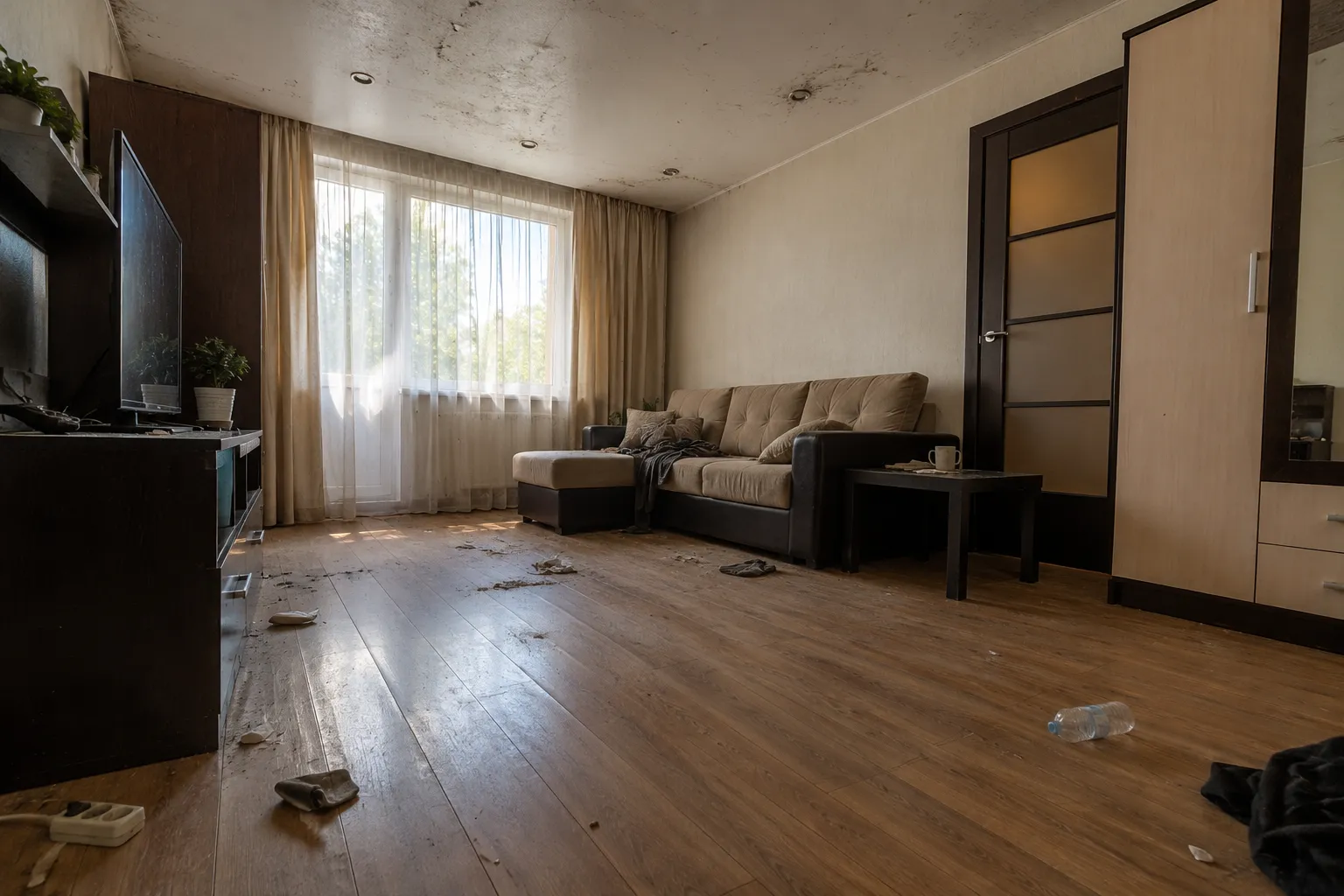
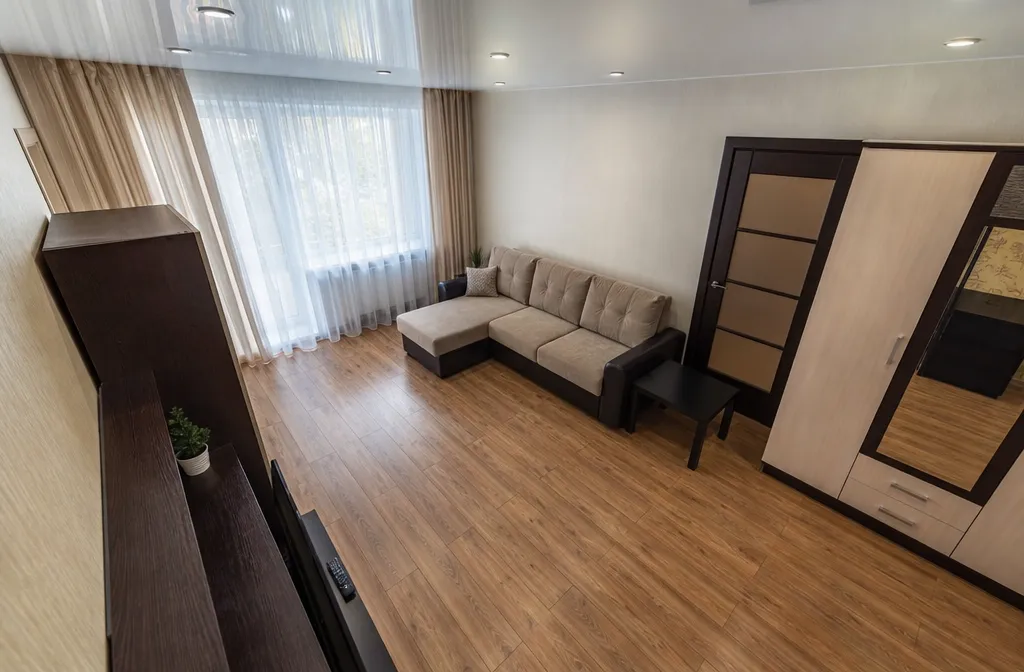
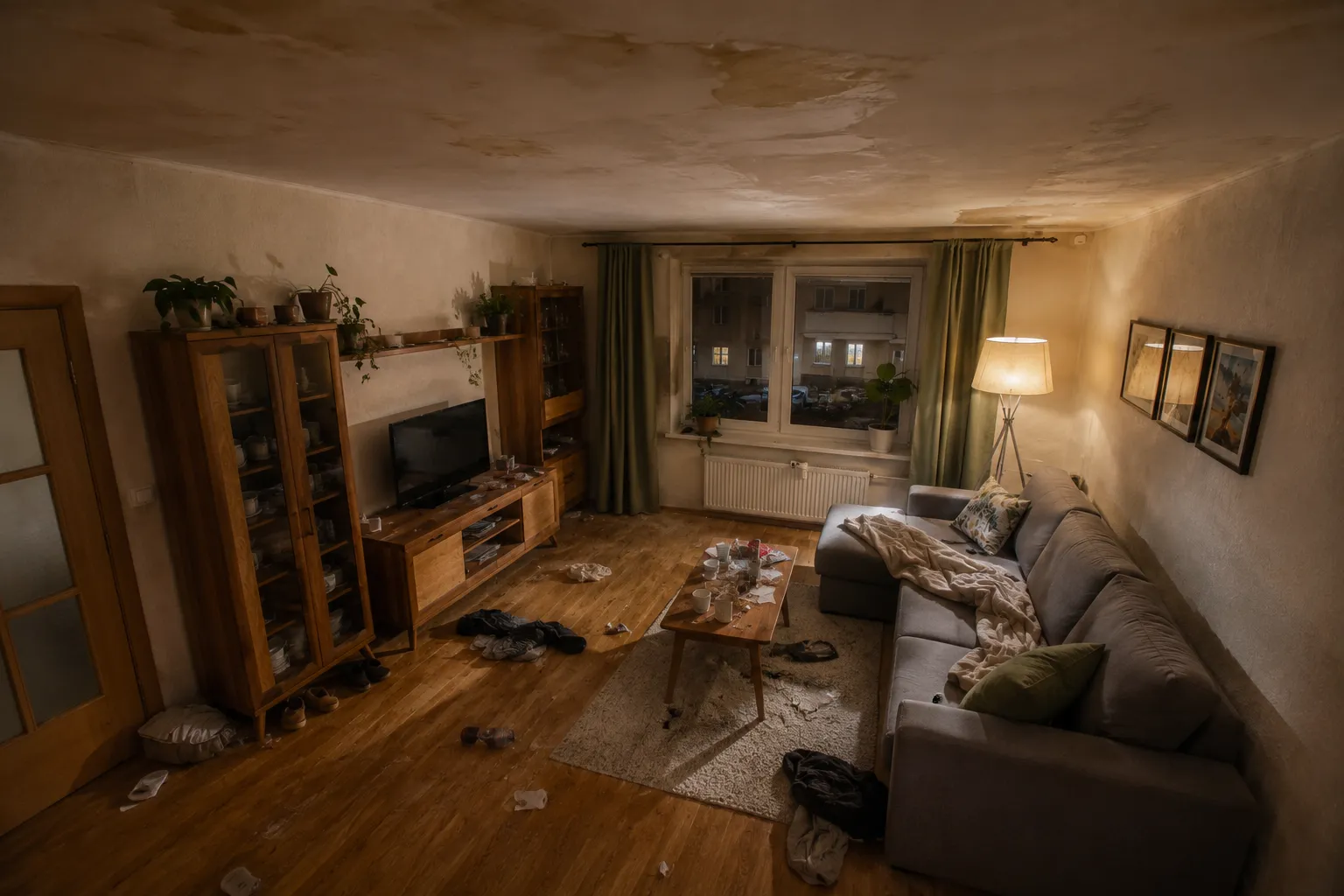
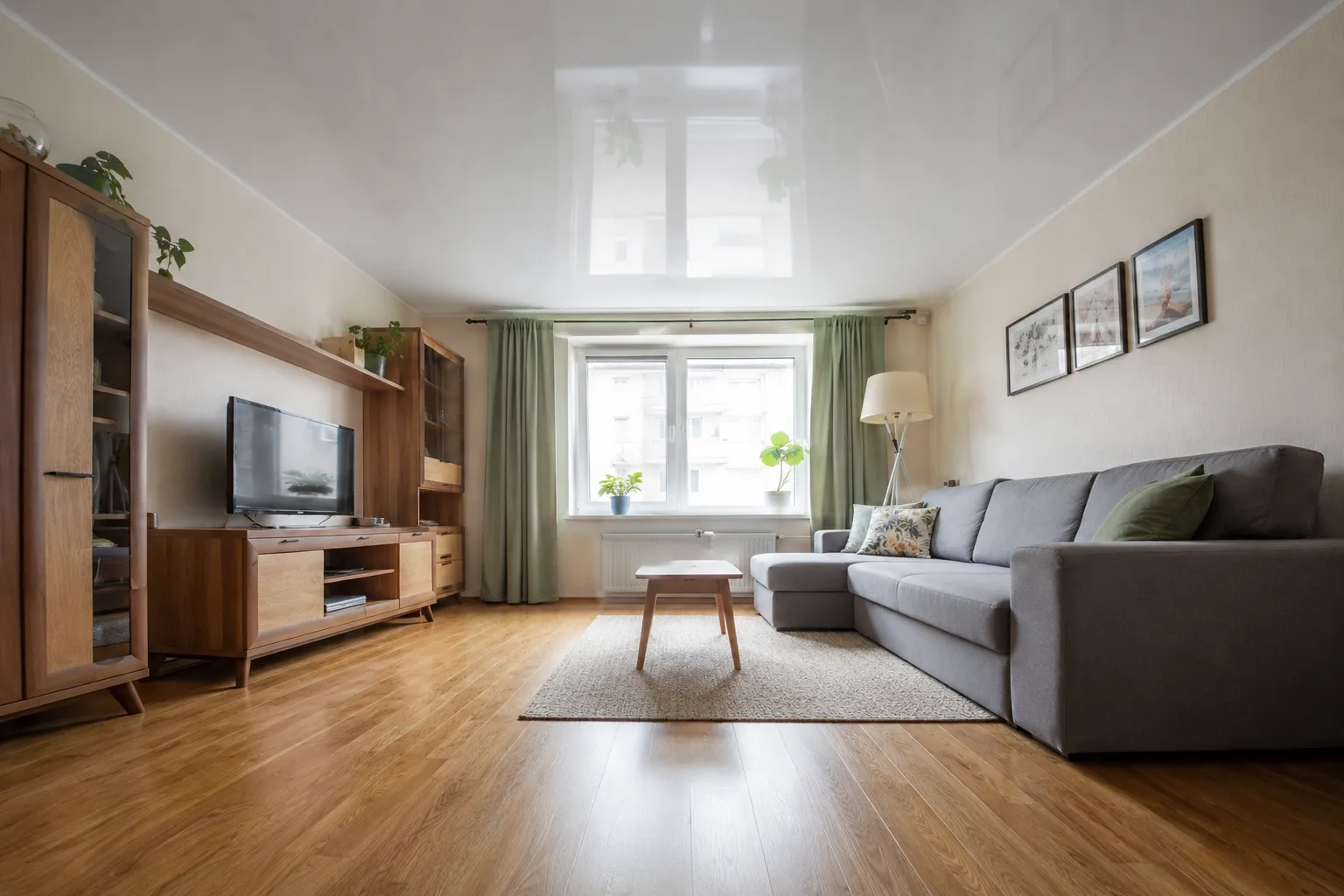
Why You Shouldn’t Use Abrasive Cleaners and Solvents
Stretch ceilings are a delicate structure, and choosing the wrong cleaning product will inevitably ruin it. We break down exactly which chemical and mechanical impacts damage the fabric, and what you cannot use as a substitute.
Abrasive Powders and Sponges with Hard Bristles
Any powder with solid particles (kitchen cleaners, baking soda, “Pemolux”) leaves micro-scratches upon contact with PVC film or fabric. On glossy surfaces, these turn into matte streaks visible from any lighting angle. On matte film, scratches are less visible but collect dust and darken over time. Melamine sponges (“magic erasers”) are also prohibited — they act like fine sandpaper, wearing away the top layer of the fabric. In our practice, after such “cleaning,” the ceiling cannot be restored: only replacing a section or the entire fabric remains an option. Only use soft microfiber cloths with a smooth texture — they won’t scratch even the most sensitive gloss.
Solvents Based on Acetone and Alcohol
Acetone, white spirit, gasoline, nail polish remover, and concentrated alcohol dissolve PVC film — it loses elasticity, becomes brittle, develops “wrinkles,” and irreversible white spots appear. Even a weak acetone solution (e.g., in paint removers) eats through the top layer in seconds. Fabric ceilings (e.g., Descor) are more resistant, but alcohol washes out their water-repellent impregnation, after which the ceiling starts absorbing moisture, dust, and odors. The only exception is 70% isopropyl alcohol for spot removal of marker or glue residue, but only after testing on an inconspicuous area and with immediate rinsing with water. Never use products labeled “solvent” or “degreaser” without checking their composition.
Acidic and Alkaline Compounds
Strong acids (citric acid, acetic acid in concentrations above 5%, rust removers) and concentrated alkalis (caustic soda, drain cleaning gels) react with the polymer. PVC film becomes cloudy, loses its shine, and may bubble under their influence. On fabric ceilings, alkali destroys the threads and impregnation, leaving a loose surface that cannot be cleaned. In Almaty apartments with hard water, people often try to remove limescale with vinegar — this is a mistake: a weak vinegar solution (1:10 with water) is only acceptable for spot stain removal, not for washing the entire ceiling. For regular cleaning, use neutral pH products (5.5–7 pH) — for example, special compounds for stretch ceilings or diluted unscented liquid soap.
Rough Mechanical Brushes and Scrapers
Brushes with metal bristles, hard plastic scrapers, blades, and knives are strictly prohibited — they cut or tear the fabric. Even a soft plastic brush with sharp edges leaves scratches on gloss. Attempts to scrape off dried dirt or paint with a blade are especially dangerous: one awkward move and the ceiling is torn. Replace any scrapers with a plastic spatula with a rubber attachment or simply a damp microfiber cloth. If a stain doesn’t come off, don’t rub harder — apply the product for 5–10 minutes to soften it, then remove it without pressure.
Chlorine-Based Bleaches
“Belizna,” Domestos, and products with sodium hypochlorite discolor colored stretch ceilings — beige turns yellow, blue turns gray, and white may yellow unevenly. On glossy fabrics, chlorine destroys the shiny layer, making the surface matte and rough. On fabric ceilings, chlorine burns the dye, leaving unremovable stains. If you need to remove mold (a common problem in Almaty bathrooms with poor ventilation), use 3% hydrogen peroxide — it is safe for the fabric and leaves no traces, but only after testing on a hidden area.
Why a Steam Cleaner is Dangerous for a Stretch Ceiling
Many stretch ceiling owners believe steam is a universal and safe cleaning method. In reality, hot steam under pressure is one of the main causes of fabric deformation, which we at profi-clean see in requests for emergency restoration. Let’s break down the risks a steam cleaner poses and how to distinguish safe damp cleaning from destructive treatment.
Critical Temperature and Film Relaxation
PVC film of a stretch ceiling is designed for operation at temperatures up to +50–60 °C. The steam jet from a household steam cleaner reaches 95–100 °C at the outlet, and 75–85 °C at a distance of 5–10 cm from the nozzle. This is enough for the film to transition into a viscous-flow state: it loses elasticity, sags, and ripples. In practice, we have taken calls where, after self-treatment with steam, the canvas dropped by 5–8 cm in the center of the room — restoring the geometry was only possible with a complete reinstallation. For fabric ceilings, thermal deformation manifests as local bulges that do not disappear after cooling. Therefore, we use only cold water (up to 30 °C) and microfiber with neutral chemicals — this is the only way not to damage the structure of the canvas.
Harpoon rupture and damage to fastenings under pressure
A steam cleaner delivers steam at a pressure of 3–5 bar in a narrow jet. If you direct the nozzle at the joint of the canvas with the wall, steam enters the gap between the harpoon and the baguette. Under pressure, the PVC film tears out of the fastening — resulting in a tear 10–30 cm long that cannot be glued, only requiring a complete replacement of the canvas. In our orders, every fourth case of stretch ceiling damage is specifically related to a steam cleaner — clients tried to wipe off old cigarette plaque or soot. Moreover, the manufacturer’s warranty on the ceiling is voided if the inspection report indicates thermal or mechanical impact from steam. Before cleaning a kitchen ceiling, make sure the cleaner uses a lint-free cloth and a spray bottle, not a steam nozzle — this is the only safe method.
Streaks and residue after condensate dries
Steam leaves a thin layer of distilled water on the canvas, which, when evaporating, forms a limescale residue from impurities dissolved in tap water. On glossy ceilings, this looks like white matte spots; on matte ceilings, it appears as uneven grayness that shows up 1–2 days after cleaning. In our orders for re-washing due to residue, the steam cleaner is the cause of a significant number of calls, and removing such streaks without leaving new ones is only possible with a special anti-static compound that neutralizes hardness salts. Almaty water (average hardness 7–8 mg-eq/L) produces sediment faster than in regions with soft water — which is why on all our visits we use only demineralized water for the final wipe-down.
How often to wash stretch ceilings in different rooms
The frequency of washing a stretch ceiling depends not on the calendar, but on the type of room and the intensity of soiling. In living rooms and bedrooms, a one-time dry cleaning every six months is sufficient, but in the kitchen and bathrooms, the schedule is entirely different.
Every 3–4 months: kitchen and cooking area
In the kitchen, the stretch ceiling suffers from micro-droplets of grease and steam that settle on the PVC film as a sticky layer. This is not just an aesthetic issue — the grease residue attracts dust, and within 2–3 months after a general cleaning, the ceiling turns yellow in patches, especially above the stove. In our orders, kitchens come in most often: soot sets in faster if the stove is gas. For matte canvases, a soft microfiber cloth with a neutral pH soap solution is sufficient; for gloss, an alcohol-based polish without acetone. If you cook daily on 2–3 burners, shorten the interval to 2.5 months — the sticky layer becomes noticeable to the touch by this time.
Every 6–8 months: bedroom and living room
In living rooms without sources of soot and steam, the ceiling is mainly soiled by dust settling and occasional insect marks near light fixtures. Here, the main task is not to wear down the canvas with frequent chemical contact, but to carefully remove dry dust every 4–5 months with a vacuum cleaner and a soft brush. Full wet washing in the bedroom is required no more than once every 8 months, and only if the room has open windows facing a busy street — for example, Abay Avenue in Almaty. On glossy ceilings in the living room, streaks are more noticeable, so after wet cleaning, we always wipe the canvas dry with a microfiber cloth. In our practice, profi-clean cleaners note that in bedrooms with air conditioning, 30% less dust accumulates — there, the interval can be extended to 10 months.
Once a year or less: hallway, entrance hall, dressing room
In walk-through areas and dark rooms, a stretch ceiling hardly encounters active dirt — at most, dust at the joints with cornices and the occasional cobweb in corners. Here, dry cleaning once every 12–14 months is sufficient, and wet washing may only be needed after renovations in an adjacent room (dust from sanding walls settles on the ceiling fabric as well). In windowless hallways where people smoke or use aroma diffusers with oils, residue from nicotine and ethers settles faster — there, the interval shortens to 8–9 months, and it’s better to use hypoallergenic, odorless Sodasan chemicals to avoid mixing scents. If there’s an open shoe rack in the hallway, dust from soles rises into the air, and once every six months, it’s worth at least wiping the ceiling with a dry cloth.
Every 1–2 months: bathroom and toilet without ventilation
The bathroom is the trickiest case: condensation from hot water mixes with particles of cleaning products and cosmetics, leaving a whitish film on the matte ceiling that hardens over time. In toilets without forced ventilation, humidity stays at 70–80% after a shower, and within a month, microorganisms appear on the PVC film — black spots in the corners of seams. Cleaning every 6–8 weeks is mandatory, and without abrasives: only a soft sponge and a solution with an antibacterial component (e.g., with the addition of 3% hydrogen peroxide, but not chlorine). If you have a glossy ceiling in the bathroom, the film is visible within 2–3 weeks — there, it’s better to wash it once a month, otherwise streaks will remain permanently after drying. Our clients in Almaty with combined bathrooms without windows typically order stretch ceiling cleaning every 2 months — this is the optimal interval to prevent black mold near the ventilation opening.
What to do when yellow stains from leaks appear
Yellow streaks from upstairs neighbors are the most common issue our ceiling owners contact us about. The sooner you act after a flood, the higher the chance of saving the fabric without re-stretching.
Why regular household chemicals don’t work
Standard products for washing windows or kitchen surfaces are useless against leaks: they don’t break down organic matter, only smear it across the film. Soapy water washes off only the top layer, but the yellow pigment remains in the micropores of the PVC. In our practice in Almaty, there was a case where, after five unsuccessful attempts to wipe off a stain with dish soap, the owner burned the fabric with a hairdryer — the entire ceiling had to be replaced. Only a professional emulsion based on surfactants with a neutral pH works — it penetrates the film’s structure and extracts the pigment without heat or friction.
Why trying to paint over the stain is dangerous
Some try to mask a yellow stain with water-based paint or acrylic ceiling spray — this is a grave mistake. Paint applies unevenly to PVC, peels off within 2–3 weeks, and mold remains underneath if water has stagnated. On a matte fabric, the patch is visible from the doorway; on a glossy one, it glares under lights. We’ve encountered apartments in Almaty where, after such “masking,” the ceiling had to be removed — the paint had soaked into the film and couldn’t be washed off even with solvents. There’s only one solution: first, professional stain extraction, and if that doesn’t work — replacement of the fabric segment.
When the ceiling has already sagged — action algorithm
If the fabric has sagged or formed a “bubble” after a leak, act without delay. First, cut off the electricity to the lighting circuit — water flows into recessed lights, and a short circuit in Almaty’s high-rises with damp wiring can happen within minutes. Then, drain the water through the nearest light fixture (if it’s surface-mounted, not recessed) — carefully detach the edge of the fabric from the baguette and drain 5–10 liters into a basin. After that, call the cleaners: we treat the leak area with an antiseptic, dry the inter-ceiling space with a construction hairdryer, and restore the harpoon tension in 2–3 hours. Don’t delay: stagnant water causes fungus on the concrete slab within 48 hours, which shows through the PVC even after drying.
How to distinguish a leak from condensation
By the type of stain, you can understand what exactly happened. A leak produces a distinct yellow-brown stain with uneven edges, often with a dark rim — this is organic matter from the riser or ceiling. Condensation creates cloudy white streaks without color, localized above the kitchen or bathroom, where steam rises to the cold ceiling. In Almaty’s new buildings with poor ventilation, condensation is mistakenly taken for a flood, and people aggressively rub the canvas, leaving scratches. A simple check: press a dry napkin against the stain for 10 minutes — if it gets wet, it’s condensation and airing the room is enough; if it stays dry, the profi-clean team arrives with an extractor for organic matter.
Care Features for Fabric Stretch Ceilings
Fabric stretch canvases differ from PVC films in structure and reaction to moisture, so caring for them requires a different approach and set of products.
Why Fabric Cannot Be Washed Like PVC Film
Polyester fabric with a polyurethane impregnation is a microporous material that absorbs water if applied in excess. Unlike PVC film, where a drop rolls off, on a fabric canvas water leaves a dark stain that dries in 1–3 days and may show streaks from dissolved dust. Because of this, sprayers with wet mist, steam cleaners (above 60 °C destroy the impregnation), and brushes with stiff bristles are prohibited — they leave pills on the surface. In our orders for fabric ceilings in Almaty, we only use microfiber with long pile (450 g/m²), slightly dampened in a neutral solution of chlorine-free fabric softener, and immediately dry it — this is the only safe method for a matte texture.
The Mistake of Using Fabric Softener for Stain Removal
Stains on a fabric ceiling — from wine, coffee, or grease — owners often try to remove with fabric softener, leaving it on for a few minutes. This is a mistake: the softener contains cationic surfactants and silicones, which after drying create a greasy film on the canvas, attracting dust faster than before cleaning. In practice, in Almaty, where the air is dusty due to the proximity of the desert, such a film turns the ceiling gray in 2–3 weeks. Another method works: apply a gel for washing delicate fabrics (pH 5.5–6.5) to a fresh stain for 30 seconds, then blot it with a dry microfiber cloth without rubbing. For old stains, such as from leaks, we treat them with a special enzyme composition that breaks down organic matter without damaging the impregnation — this takes 15–20 minutes, after which only a dry napkin remains.
Winter Care for Fabric Canvas in Almaty Conditions
In winter, in Almaty apartments due to heating, humidity drops to 18–25%, and fine soot from coal heating in the private sector and exhaust fumes is brought in from the street through slightly open windows. The fabric canvas, like a sponge, absorbs this suspension — after a month and a half, a sticky gray coating appears that cannot be washed off with water without surfactants. We have noticed that on fabric ceilings in bedrooms and living rooms facing Timiryazev or Sain streets, this coating settles 2–3 times faster than on similar surfaces in houses in the Samal microdistrict. Therefore, in winter, I recommend dry treating the fabric ceiling once every 2 months: go over it with a brush with natural bristles (soft, like for cashmere) with an electrostatic effect — this removes the coating without moisture and extends the period before wet cleaning from 6 to 10–12 months.
How to Clean a Fabric Ceiling in the Kitchen Without Risk of Streaks
In the kitchen, a fabric ceiling accumulates greasy condensation from cooking — it’s not just dusty, but oily, and any water with a regular detergent smears it into rainbow streaks visible under lamps. Instead of a universal product, we use a degreaser based on citrus solvents (d-limonene), which is applied to a dry cloth, not to the canvas — drop application to the fabric leaves a greasy ring. Movements are only along the seam direction, from the center to the edges, without circular rubbing, to avoid stretching the impregnation. In our practice, in a kitchen in the Atakent area, a 12 m² ceiling was cleaned in 40 minutes without a single streak — the secret is that the cloth was changed every 2 passes, not wrung out in a bucket of dirty water. If the kitchen has a hood, the frequency of wet cleaning for a fabric ceiling is once every 4–5 months; without a hood, once every 2 months, otherwise the oily coating eats into the impregnation and is only removed along with part of the polyurethane layer.
How to Avoid Streaks on a Glossy Ceiling
Even a perfectly washed glossy ceiling can look untidy if whitish streaks remain after drying. Streaks are the result of improper washing technique or choosing the wrong tools.
Why streaks appear on gloss
The main reason is using a cloth that is too wet. Water with dissolved dust rolls into droplets on the smooth PVC film and, upon drying, leaves salt deposits. In Almaty, the water is hard (calcium and magnesium salt content above 5 mg-eq/L), so the risk of streaks is higher than in cities with soft water. The second factor is the unsuitable cloth material: terry cloth leaves lint, while foam rubber spreads dirt in a thin layer. The third reason is washing in circular motions, which do not remove residue but rub it across the entire surface of the canvas. In our practice, after poor-quality cleaning by third-party cleaners, we removed streaks in 9 out of 10 cases — most often because they used a universal glass cleaner, which is too aggressive for PVC film. To avoid streaks, use microfiber with a density of 350-400 g/m² (blue or green, without an abrasive insert) and wring it out until it is “barely damp” — drops should not run down your hand.
Which washing method gives a streak-free shine
We wash glossy ceilings using a two-pass technique: first a damp wipe, then a dry polish. The first pass uses a microfiber cloth moistened with a solution of hypoallergenic Kiehl cleaner (pH 7.0) and wrung out to 80% dryness. Movements are strictly parallel to the wall from the window, with each strip overlapping by 5-7 cm to avoid missing any area. The second pass uses a dry cloth made of the same microfiber, which is used to polish the surface immediately after the damp treatment, while the film is still wet. On glossy canvases of dark shades (black, chocolate, wenge), streaks are more visible — for these, we use distilled water, which leaves no salt residue after evaporation. If you have a light gloss, filtered water may suffice, but for dark canvases, distilled water is mandatory.
When a glossy ceiling should not be washed at all
A newly installed ceiling (the first 2-3 weeks after installation) should not be touched — the film is stretching and settling, and any mechanical impact disrupts the tension. Washing is also prohibited if the ceiling has micro-cracks from building shrinkage or improper installation — moisture will seep under the film, causing permanent yellow stains. In Almaty’s older housing stock (“Khrushchev-era” buildings in the “Samal-2”, “Samal-3” microdistricts), temperature fluctuations are common due to poor floor insulation — washing gloss during the cold season causes condensation on the canvas, preventing even drying and guaranteeing streaks. In such cases, we recommend postponing cleaning until the room is consistently at +20..+22°C, or drying the ceiling with a construction heat gun at a minimum temperature (60°C) from a distance of 40-50 cm.