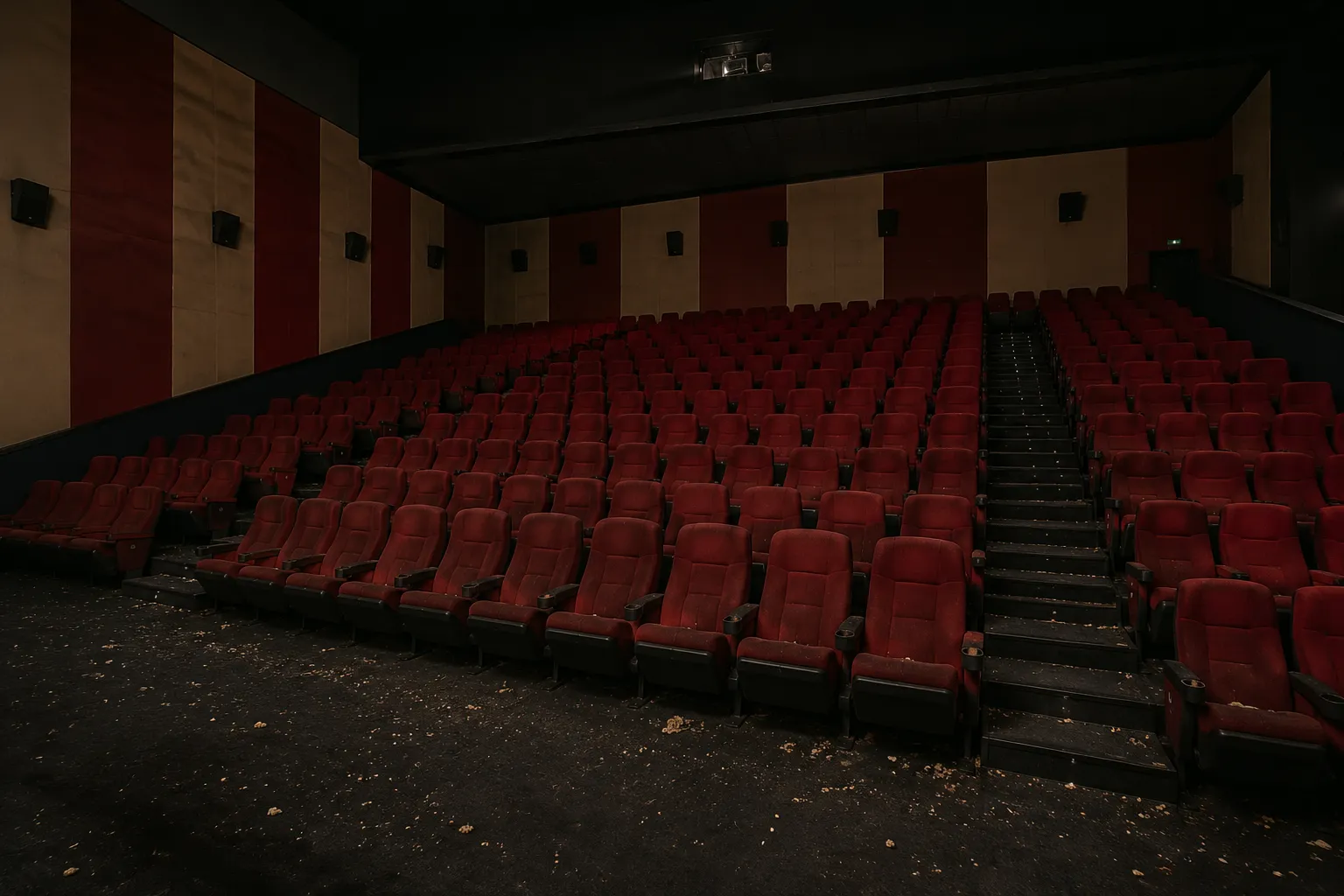
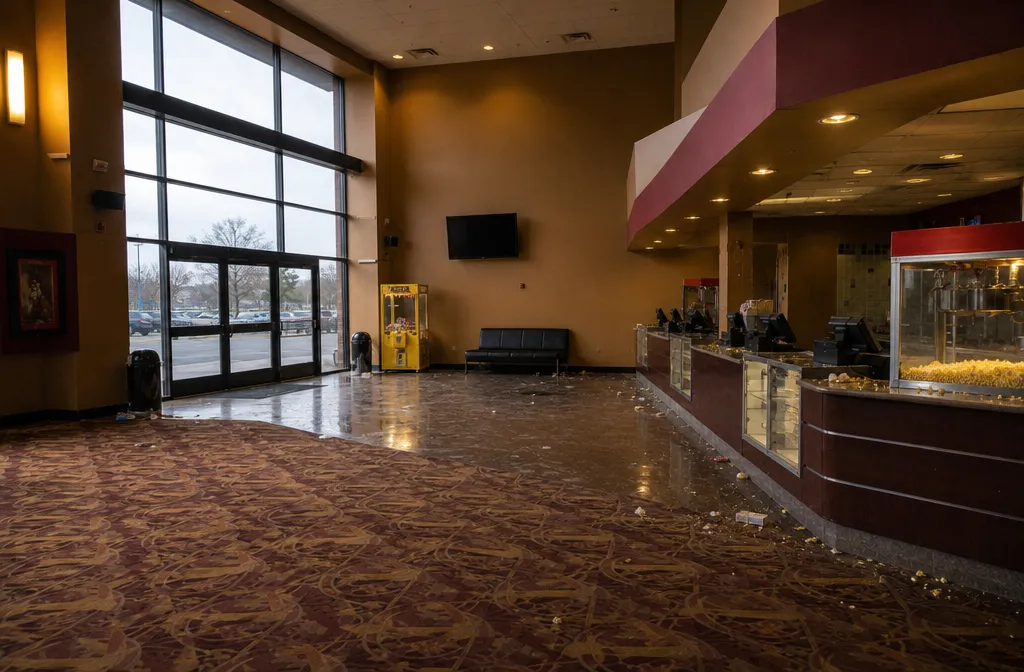
Specifics of Contamination in Cinemas: Popcorn, Grease, Chewing Gum
Unlike standard commercial spaces, cinema halls accumulate a unique set of contaminants — an oily film from popcorn, dried soda, embedded chewing gum, and skin grease from viewers, which all mix into a persistent layer on seats, floors, and glass display cases. Without understanding the nature of these stains, regular cleaning leaves streaks, and incorrect chemicals can set the contamination permanently.
Why Popcorn and Soda Are the Worst Combination for Seats
Popcorn oil — refined coconut or palm oil with a melting point of around 36°C — upon contact with seat fabric, deeply absorbs within 15-20 seconds and forms a greasy film to which powdered sugar and crumbs instantly stick. In our experience, just one evening show in a 200-seat hall is enough for a sticky layer to form on armrests and backrests, which cannot be washed off with standard foam. If soda is spilled on top of this oil, the sugar caramelizes under the weight of viewers, and within 2-3 days the stain darkens to brown, embedding into the polyester to a depth of 0.5-0.7 mm. At Almaty screenings with popcorn in large buckets — which accounts for 80% of orders according to our observations — the oil additionally splatters onto neighboring seats, and without preliminary enzyme treatment, it cannot be removed. Therefore, for seats, we use an alkaline pre-spray with a pH of 9.5-10 and steam cleaning at 120°C — this breaks down the grease into glycerin and soap without leaving streaks.
How Chewing Gum Damages Flooring in the Hall
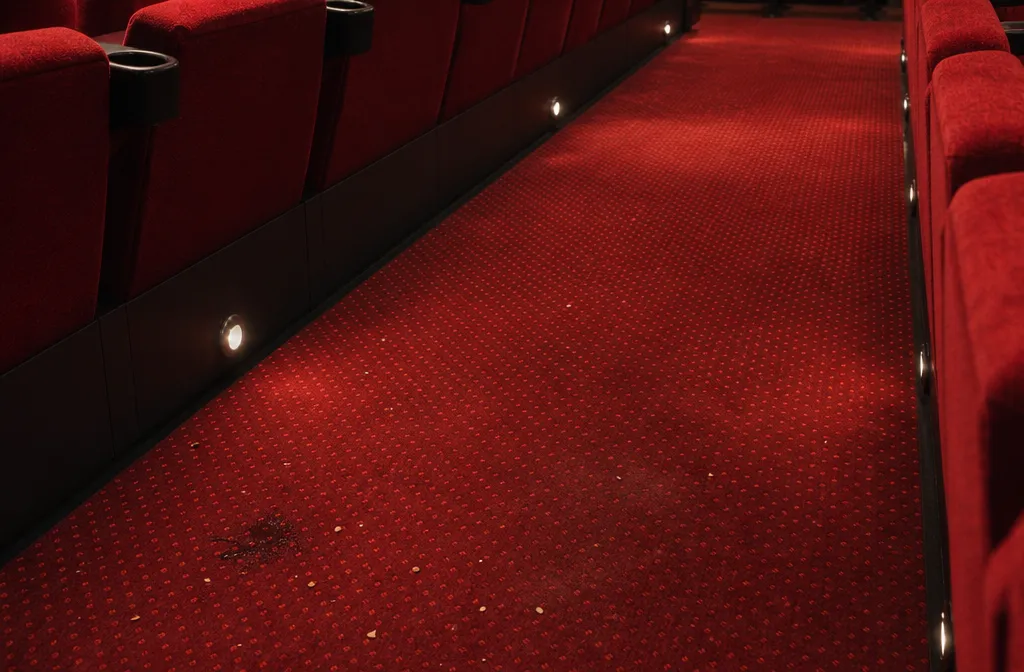
Gum on a cinema floor is not just litter: under the pressure of viewers’ shoes, it gets pressed into the pores of carpet or micro-cracks in tiles, and within 24 hours, the polymer base (butyl rubber or vinyl acetate) fuses with the fibers at a molecular level. In carpet with a pile height of 8-12 mm — standard for business-class cinemas in Almaty — gum penetrates to a depth of up to 5 mm, and mechanical scraping tears out fibers, leaving bald spots. We treat such areas with freezing down to -50°C using the cryogenic aerosol Crio-Gum: the gum becomes brittle and separates from the fibers as a single block without damaging the base. On tiles, especially in the lobby with glossy porcelain stoneware, gum leaves a grease residue invisible to the naked eye but glowing yellow under ultraviolet light — it is this film that causes slipping if not removed with an alcohol solution. In our substantial orders, we always include a UV floor inspection before handover.
Where Streaks on Glass Display Cases Come From and How to Avoid Them
Streaks on lobby glass are not the result of poor work but of incorrectly chosen pH: if a product for greasy popcorn (alkaline) accidentally gets on the glass, it leaves a rainbow film of unrinsed salts. Cinema glass display cases are often not ordinary silicate glass but tempered glass with an anti-glare coating: aggressive chemicals with a pH above 10.5 or abrasive sponges destroy this coating within 2-3 cleanings, and the glass becomes irreversibly cloudy. For display cases, we only use a neutral solution with a pH of 7.0-7.5 based on alkyl polyglucoside — it removes fingerprints and dust without leaving a film. On Almaty sites with panoramic windows on the first line, we additionally apply an antistatic agent: it reduces dust settling from the street by 70% in dry weather — and the city is dusty even on weekdays, especially after wind from the south.
Grease on Handrails and Railings — A Hidden Source of Stickiness
Handrails in lobbies and corridors are a “collector” of skin oil, sweat, and hand cream residue from thousands of viewers per day: during one hour of screenings, up to 0.2 grams of lipids accumulate on a 3-meter-long handrail, which oxidize and become sticky. If handrails are only wiped with water — the grease does not dissolve but gets smeared, and within a week a hard film forms that attracts dust like a magnet. We wash handrails in two stages: first, a degreaser with isopropyl alcohol (30% concentration) — it softens the oxidized lipids, then water with a cationic surfactant, which leaves an antistatic film and reduces re-deposition of dust for 3-4 hours. In cinemas with children’s zones on the second floor, railings are additionally treated with a bactericidal solution based on quaternary ammonium compounds — it remains active for up to 6 hours against staphylococcus and E. coli.
Why Dust Settles Faster in Almaty Cinemas
Due to Almaty’s geographical location — a basin surrounded by mountains — an inversion layer forms in the city: warm air traps exhaust fumes and dust near the ground, and it enters cinema halls through ventilation systems. Our measurements show that in halls with mechanical supply ventilation without HEPA filters, up to 0.8-1.2 grams of fine dust PM2.5-10 settles on every square meter of floor and seats over a 12-hour workday. This dust mixes with popcorn oil and forms an abrasive paste — if not removed with wet cleaning using microfiber, it scratches the lacquered coating of armrests and matte wall panels. We use vacuum cleaners with HEPA H13 and a pre-cyclonic filter — this captures 99.97% of particles up to 0.3 microns and prevents dust from resettling on the seats. For halls with a “Dolby Cinema” system, we additionally apply air ionization after cleaning — it reduces static and extends cleanliness by 2-3 days.
How We Remove Chewing Gum from Seats and Carpet
Chewing gum is the most common and most troublesome contaminant in cinema halls: it embeds into seat fabric and carpet fibers under the weight of viewers and body temperature, and mechanical scraping without preparation only spreads the mass deeper. At profi-clean, we use a three-step technology that removes gum without damaging the upholstery and without leaving any sticky residue.
Why Chewing Gum is a Complex Type of Contamination
The structure of chewing gum — an elastomeric base with plasticizers and a sugar core — acts like a polymer-grade adhesive upon contact with fabric. On cinema seats, gum is compressed under the weight of a viewer (70–90 kg) over a one-and-a-half to two-hour session, embedding into the weave of the threads to a depth of 1–2 mm. On carpet, it additionally mixes with dust and sand from shoes, forming an abrasive paste that, when rubbed carelessly, tears the fibers. In Almaty cinemas, seasonal humidity adds to this: during summer rains and winter slush, gum on carpet swells and becomes even more firmly fixed due to the hygroscopic nature of the sugar component. In my opinion, ignoring this “moisture” effect is the main mistake of inexperienced cleaners who try to scrape off gum with a dry scraper and end up leaving “bald patches” of torn fibers on the carpet.
Thermal Method: Freezing vs. Heating — What Works for Seats
For cinema seats with fabric upholstery (velvet, microfiber, chenille), we use a cryogenic spray based on liquefied carbon dioxide — it cools the gum to –40 °C in 3–5 seconds. At this temperature, the polymer base becomes brittle and chips off the fabric in one piece without leaving any oily residue. Heating, on the other hand, is contraindicated: hot steam or a hair dryer liquefies the gum, it penetrates deeper into the seat lining and will appear as a stain after a week of use. In our practice, there was a case in one multiplex on Abay Avenue where a previous contractor treated 12 seats with a steam generator — three days later, yellow circles 5–7 cm in diameter appeared on all seats, which had to be removed with a limonene-based solvent. Therefore, for soft seats, we use only cold — it guarantees clean upholstery without secondary defects.
Method for Carpet: Solvent + Extractor Without Residue
On carpet, the cryogenic method is ineffective: the gum freezes into the fibers and tears them out when chipped off. For carpet in Almaty cinemas, we use a two-component system: applying a bio-solvent based on d-limonene (citrus extract) for 30–60 seconds to soften the polymer, then extracting with hot water at 80 bar pressure through an extractor with a Spot Cleaner attachment. 80 bar pressure is a critical threshold: at 100+ bar, water penetrates the carpet to the base and shifts the fibers, leaving “bald spots.” At 50 bar, it does not wash out the remnants of the softened gum. Our extractors are equipped with HEPA filters on the air outlet to prevent polymer particles from settling back onto the carpet. In practice, for medium-density carpet (like “Milano” or “Berber”), the procedure takes 2–3 minutes per stain, and after drying, the fibers do not stick together or lose volume.
Common Mistakes When Removing Chewing Gum in Cinema Halls
| Mistake |
Consequence |
Our Solution |
| Scraping with a dry scraper |
Torn upholstery threads, pulled pile on carpet |
Thermal or chemical preparation before mechanical removal |
| Using acetone or white spirit |
Dissolving fabric dye, discolored stains |
We only use limonene-based solvents with pH 6.5–7.0 |
| Steam treatment |
Pressing rubber into the lining, oily residue after a week |
Only cryogenic cold for seats |
| Drying with a hairdryer after removal |
Setting the residual sticky layer into the pile |
Forced cold air drying using an extractor |
Each of these mistakes is a direct result of trying to save time: a dry scraper takes 10 seconds instead of the 2–3 minutes required for proper treatment. But in Almaty cinemas with tight screening schedules (up to 7 shows per day), cleaners often take the path of least resistance, and then wonder why seats last 2–3 years instead of the manufacturer-stated 5–7 years.
Odor Control: Neutralizing Popcorn and Sweat
Odor in a cinema hall is not just discomfort—it’s a signal that organic matter is decomposing in the pores of the fabric and carpet. At profi-clean, we use a three-level system: enzymatic hydrolysis of fats, ozonation, and encapsulation of residual molecules.
Why Standard Dry Cleaning Doesn’t Remove Popcorn Smell—and What profi-clean Does
Popcorn is not just corn; it’s a mix of oil, salt, and caramel that, when heated by the viewer’s body and exposed to humidity, oxidizes, releasing rancid aldehydes. Regular vacuum extraction or wet cleaning with shampoo only removes the surface layer, while the oil remains deep in the polyester pile of “Triumph” or “Lux” seats found in Almaty cinemas like “Arman” and “Kinopark.” We use an enzymatic degreaser based on lipase—it breaks down oily chains into glycerol and fatty acids, which are easily rinsed out by a Karcher extractor with a HEPA filter. On leatherette seats (e.g., in VIP halls of “Shalym” and “Chaplin”), oil doesn’t absorb but gets trapped in seams and folds—here, a steam generator with a crevice tool pushes the grease to the surface. After that, we treat the seats with an ozonator for 15 minutes: ozone oxidizes volatile residues that the degreaser didn’t remove. In practice, this means that an hour after treatment, the hall smells neutrally clean, not like popcorn from the previous screening.
How We Neutralize Sweat Odor in Seats—A Recipe for High-Traffic Screenings
Sweat on seats isn’t water; it’s a mix of ammonia, urea, and lactic acid, which in warmth and humidity turns into a persistent “sour” smell, especially in high-traffic halls—at premieres in “Kinoforum” or “Arsenal,” up to 8 screenings pass through daily. We don’t mask the smell with fragrances: deodorizing sprays with “cotton” or “citrus” scents only mix with ammonia, creating an even harsher bouquet. Instead, we use an enzymatic spray with proteases—enzymes break down protein compounds from urine and sweat into odorless amino acids. On fabric-upholstered seats (velvet or microfiber, used in “TRC TSUM” and “ADK”), we apply the spray precisely, wait 10 minutes, and rinse with an extractor at 55°C water temperature—above that, protein coagulates and sets into the fiber, while 55°C is the optimum for protease. On leather seats in “Esentai Mall,” wiping with an enzymatic solution and drying with a fan is enough—leather doesn’t absorb, but the smell remains in the pores if the molecule isn’t broken down. After all procedures, we check the result with a halometer—the device measures ammonia concentration in the air, and if it’s above 0.5 ppm, we repeat the treatment on the problem area. In halls with evening children’s screenings, we additionally clean the armrests—children often rest their heads on their hands, and sweat soaks in there specifically.
How Odor Returns After a Week—and How to Avoid It
The most common mistake is treating only the seats, without cleaning the walls, floor, and air conditioners. The smell of popcorn and sweat settles on plaster and drywall (in the halls of “Kinopark” and “MEGA Shopping Center”, the walls are finished with acoustic panels with a porous surface), accumulates in the supply ventilation filters, and returns to the hall 3-5 days after cleaning. At profi-clean, we include duct cleaning in our odor control cycle — we remove the grilles, treat the filters with an enzyme solution, and blow them out with a 6-8 bar compressor. If the hall has an industrial dehumidifier (for example, in “Kinoforum” humidity is kept at 40-50%), we clean its drain pan — bacteria multiply there, producing the same “sour” smell as sweat. On walls and floors, we use a dry fog with bacteriophages — microparticles penetrate the material’s pores and destroy the odor at the molecular level, rather than just washing it off the surface. After this treatment, the hall stays fresh for 2-3 weeks with daily wet mopping of the floor, not just the seats.
Which products do not leave a “chemical” smell after treatment
Many cleaning companies use chlorine-based compounds — they kill bacteria, but afterwards the hall smells of bleach, which mixes with popcorn and gives a “swimming pool” undertone. We work with hypoallergenic concentrates from Kiehl and Sodasan — they contain coconut surfactants that have no inherent odor, and essential oils (tea tree or lavender) that evaporate 15-20 minutes after drying. On carpeting (in the foyers and halls of “Kinopark” with short-pile covering), we use Sodasan Teppichreiniger — it foams minimally, leaves no sticky residue, and after extraction, the carpet simply smells like damp fabric, without a “chemical aroma”. In VIP halls with parquet flooring (“Kinoforum”), we use a neutral pH Kiehl Floor Cleaner — it doesn’t dry out the wood and produces no ammonia smell, which appears an hour after cleaning if the pH is above 8. On leather seats, we don’t use alcohol wipes — alcohol dries out the leather, causing it to crack, and sweat gets trapped in the cracks, becoming impossible to wash out. Instead of alcohol, we use an enzyme foam with a pH of 5.5, which doesn’t damage the leather’s protective layer and leaves no odor after drying.
Specifics of cleaning cinemas in Almaty: climate and occupancy
Almaty’s dust, sharp humidity fluctuations, and peak weekend loads create a unique profile of soiling not found in cities with more stable climates. We have adapted our cleaning protocols to these two factors — otherwise, the carpeting in the halls loses its appearance in three months, and the air starts to smell musty by mid-week.
Dust load: how Almaty smog accelerates finish wear
In Almaty, the concentration of suspended particles PM2.5 and PM10 in the air is 3–5 times higher than in Astana or Shymkent — this is data from city monitoring stations. Fine dust settles on the carpeting, seats, and walls of cinema halls not evenly, but in layers: in the hour before a screening, with the doors to the foyer open, up to 0.3–0.5 grams of dust per square meter of flooring settles. If the hall is cleaned with a standard vacuum cleaner without a HEPA filter, some particles are blown back into the air and settle again elsewhere — in the seat pile or on velvet panels. In our protocols, we use industrial vacuum cleaners with HEPA H13 and a pre-cyclonic filter: they capture up to 99.97% of particles sized from 0.3 microns, including soot from car exhaust that enters the hall through the ventilation. The difference is noticeable in the carpet’s lifespan: with proper dust cleaning every two days, the pile retains its color and resilience for 18 months, whereas with weekly cleaning without HEPA, worn paths appear in the aisles within 8 months. Before the start of the poplar fluff season (May–June), we recommend cinemas increase the frequency of wet cleaning in the foyer to twice a day — the fluff sticks to the oily film from popcorn, creating a sticky crust that a dry vacuum cleaner can no longer handle.
Humidity and condensation: a hidden threat to seats and acoustics
Heating in Almaty cinemas runs at full power in winter, and air conditioning systems blast cold air in summer — as a result, humidity in the auditorium fluctuates from 20% in winter to 85% on rainy autumn evenings. These swings cause MDF and plywood seat frames to “breathe”: they absorb moisture from the air during the day and release it at night, forming microscopic condensation on the fabric surface. This condensation is the primary cause of yellow stains on armrests and backrests, which owners often mistakenly attribute to grease from fingers. In reality, it’s resin from the wood panels that rises with the moisture and oxidizes in the light. We solve this problem not by increasing cleaning frequency, but by selecting the right chemicals: we use neutral pH products with an anti-static effect (Sodasan Neutralreiniger), which do not compromise the fabric’s vapor permeability, meaning condensation evaporates evenly without leaving streaks. Another nuance is the acoustic panels on the walls: at high humidity, they swell and lose their sound-absorbing properties, so during deep cleaning we only treat them with dry microfiber and a special water-based antibacterial spray without soaking. If the cleaning regime isn’t adjusted for the season in time, after two heating seasons the seats start to creak, and the auditorium acoustics become “muffled” — viewers complain about indistinct dialogue sound.
Weekend Peak Load: When Regular Cleaning Isn’t Enough
On Friday evenings and weekends, the occupancy of Almaty cinemas reaches 85–95% — 2.5 times higher than on weekdays. In a single evening, up to 1,500 people pass through the lobby, each leaving behind: popcorn crumbs, wet shoe prints (with dirt in autumn, with de-icing agents in winter), and spilled drinks. If a cleaner only goes through the auditorium after the final screening (at 11:00 PM–12:00 AM), the marks have 6–8 hours to dry and set into the carpet. In our practice, we have implemented an “inter-screening pass”: between shows (usually a 15–20 minute break), a cleaner with a handheld vacuum and microfiber collects large debris from the aisles and wipes down the armrests of the first three rows — the highest contact zones. This doesn’t replace the nightly cleaning, but it reduces the time needed to remove set-in stains by 40%, because sticky residues don’t have time to polymerize. A separate challenge is children’s matinees on Saturdays: after cartoon screenings, seats are left with traces of cotton candy, chocolate, and juice. The sugar base of these stains attracts dust like a magnet, and if not cleaned within an hour, a sticky film forms that later requires a special desugarizer to remove. In auditoriums with children’s screenings, we use express steam treatment of the seats (130 °C) immediately after the morning show — this dissolves the sugar and kills bacteria without chemicals, which is critical for allergy sufferers among the young viewers. For cinemas running blocks of 4–5 children’s screenings a day, we recommend assigning one dedicated cleaner per shift on weekends — their work pays off by eliminating complaints about sticky seats and the smell of soured juice.
Seasonal De-icing Agents: How Salt and Sand from Almaty Streets Destroy Carpet
In winter and early spring, Almaty’s sidewalks are treated with a sand-salt mixture: sodium and calcium chlorides are tracked on shoes into the lobby, and from there into the screening rooms. Large salt crystals mechanically cut the carpet fibers underfoot, while dissolved salt forms a white residue upon drying that embeds into the fibers and cannot be removed with plain water. Wet cleaning without salt neutralization only worsens the problem: water dissolves the crystals deeper, and after drying, the salt resurfaces even more actively. We use a two-stage protocol for the lobby during the winter season: first, dry mechanical cleaning with an industrial vacuum cleaner and a crevice tool (collects large crystals), followed by wet treatment with a special salt neutralizer (pH 6.0–6.5), then rinsing with clean water and drying with a turbo dryer in 20 minutes. If this isn’t done, by March irreversible faded stripes appear on the carpet in the aisles — the salt bleaches the dye from nylon or polypropylene. At the entrance to the auditoriums, we recommend installing rubber dirt-trapping mats at least 3 meters long (standard 1.5-meter mats don’t catch all the dirt) and changing them every two hours on peak days. According to our observations, cinemas that ignore this step replace their lobby carpet every 1.5 years — twice as often as those that clean with a salt neutralizer.
Why It’s Important to Trust Cleaning to Professionals: Risks of DIY Cleaning
Cleaning a cinema independently by staff or hired unqualified cleaners is one of the main reasons for rapid wear of seats, damage to carpeting, and accumulation of hidden dirt. Let’s break down the specific risks of an amateur approach and why saving on professional cleaning leads to losses.
Damage to Upholstery and Carpeting
The most common mistake during DIY cleaning is using household chemicals and improvised means to remove oily residue and chewing gum. Regular chlorine-based stain removers or abrasive powders burn the pigment on fabric seats, leaving irreversible white spots, while acetone-based solvents destroy the polyurethane coating of the carpet, making it “bald” after 3-4 treatments. At profi-clean, we work exclusively with professional enzyme-based formulations from Kiehl and Sodasan: they break down fat and protein at the molecular level without affecting the fiber structure. Equipment with HEPA filtration and adjustable steam temperature prevents the pile from “cooking,” as happens when using a household steam cleaner at 100°C — our technology extends the lifespan of coatings by 2-3 seasons compared to DIY cleaning.
Bacterial and Mold Growth Due to Under-Dried Surfaces
When wet cleaning with a regular mop or manual vacuum, up to 30-40% of moisture remains in the thickness of the carpet — this is enough for mold fungi Aspergillus and Penicillium to start growing in a warm, dark hall within 12 hours. DIY cleaning rarely includes drying: staff simply leave windows open, but in Almaty cinemas with forced ventilation systems, natural drying takes 6-8 hours, and in the under-seat space — up to a day. Our extraction process is different: after applying chemicals and vacuuming, we run the carpet through a turbo-dryer with an airflow of 65-70°C for 20-30 minutes per hall — residual humidity does not exceed 8%, which eliminates the development of microorganisms. In practice, this means that after our cleaning, there is no characteristic “musty” smell in the hall, which appears a day or two after DIY washing.