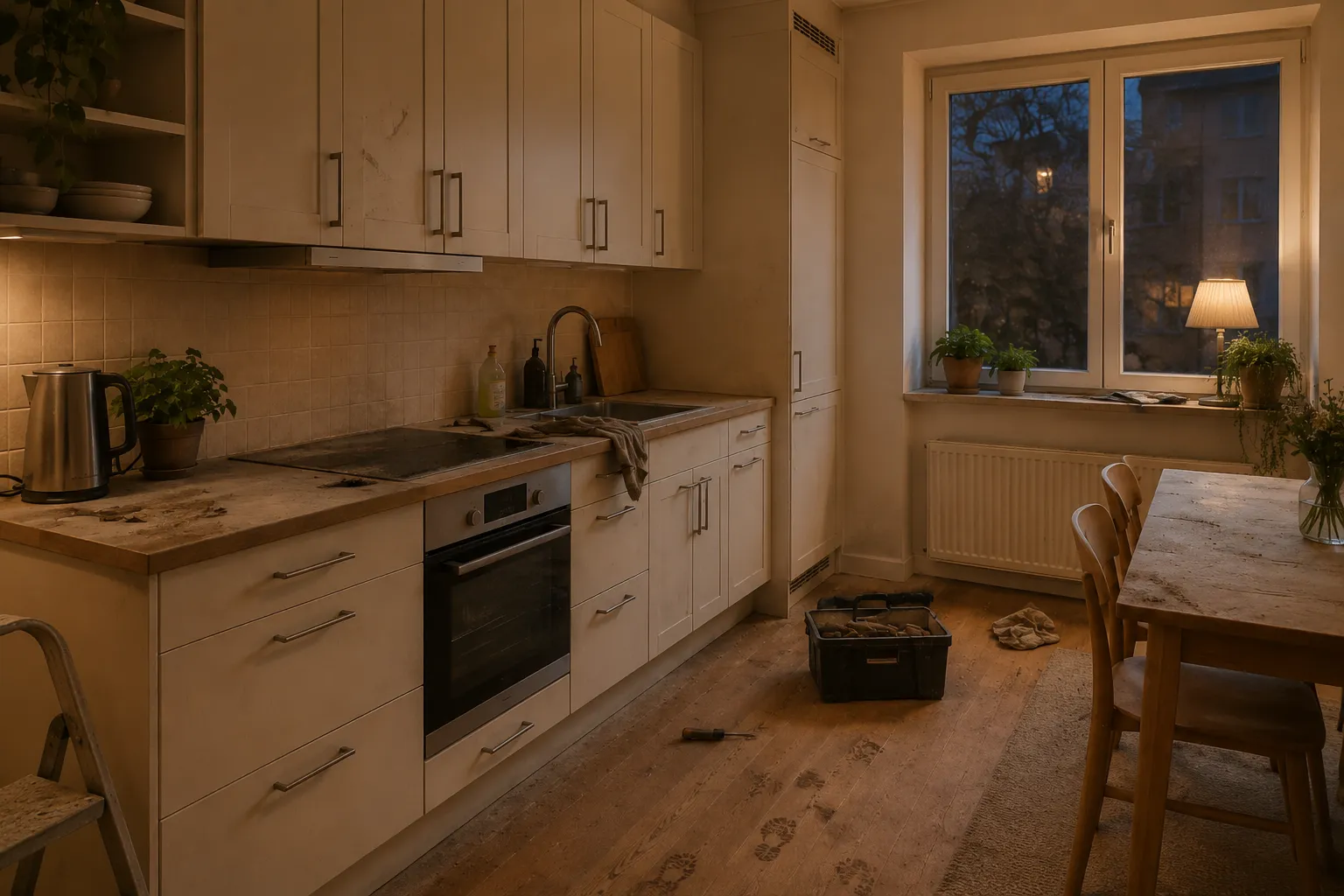
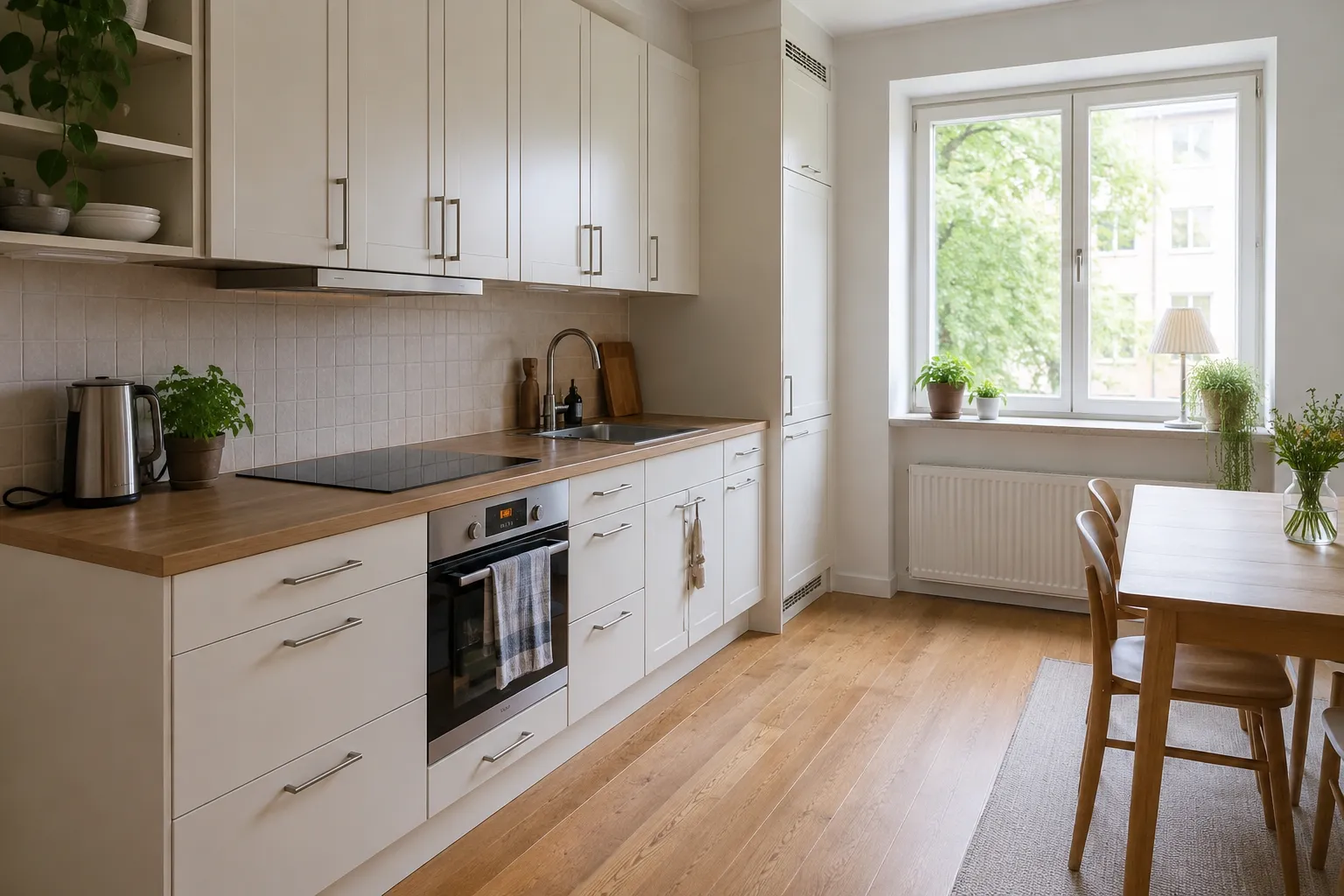
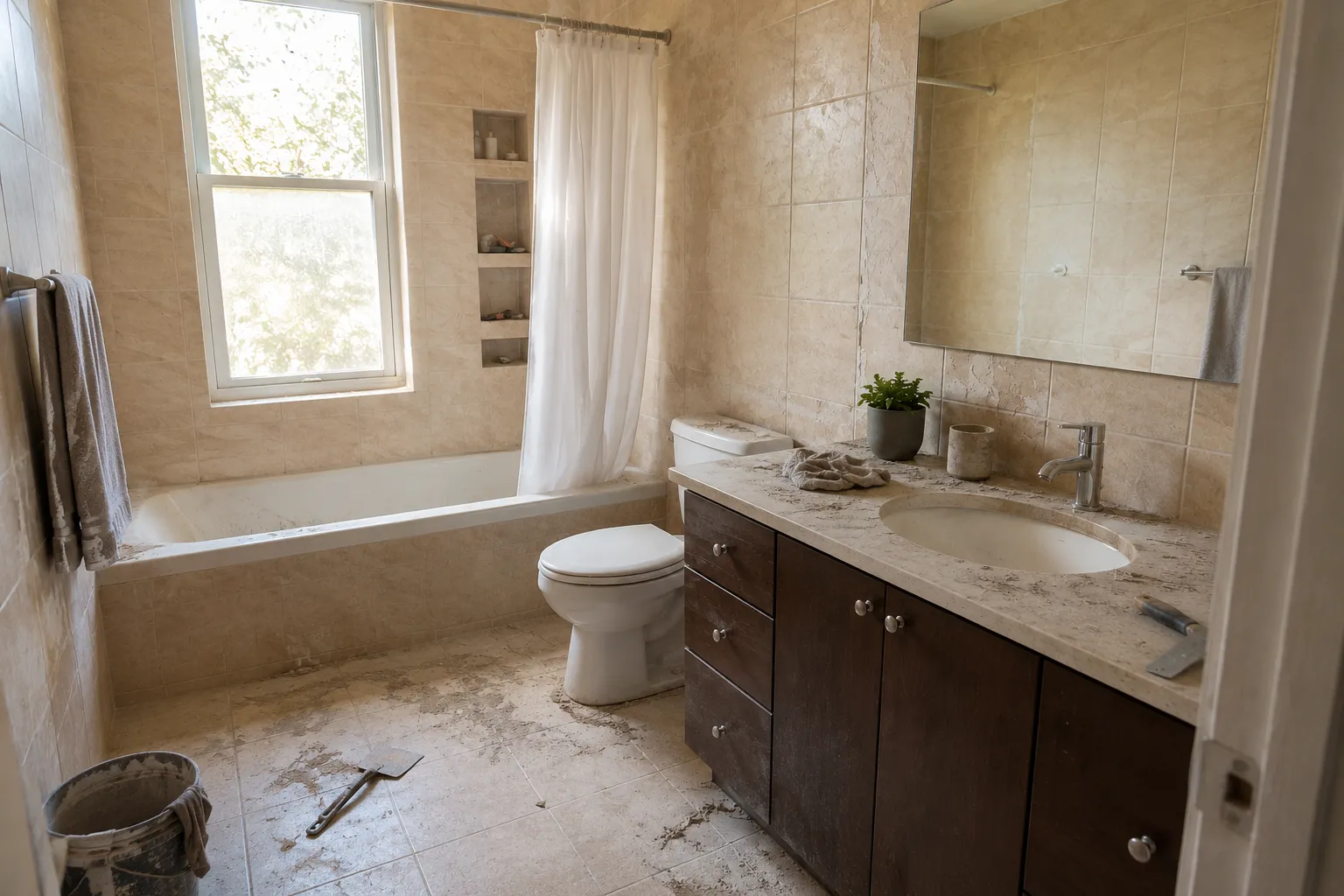
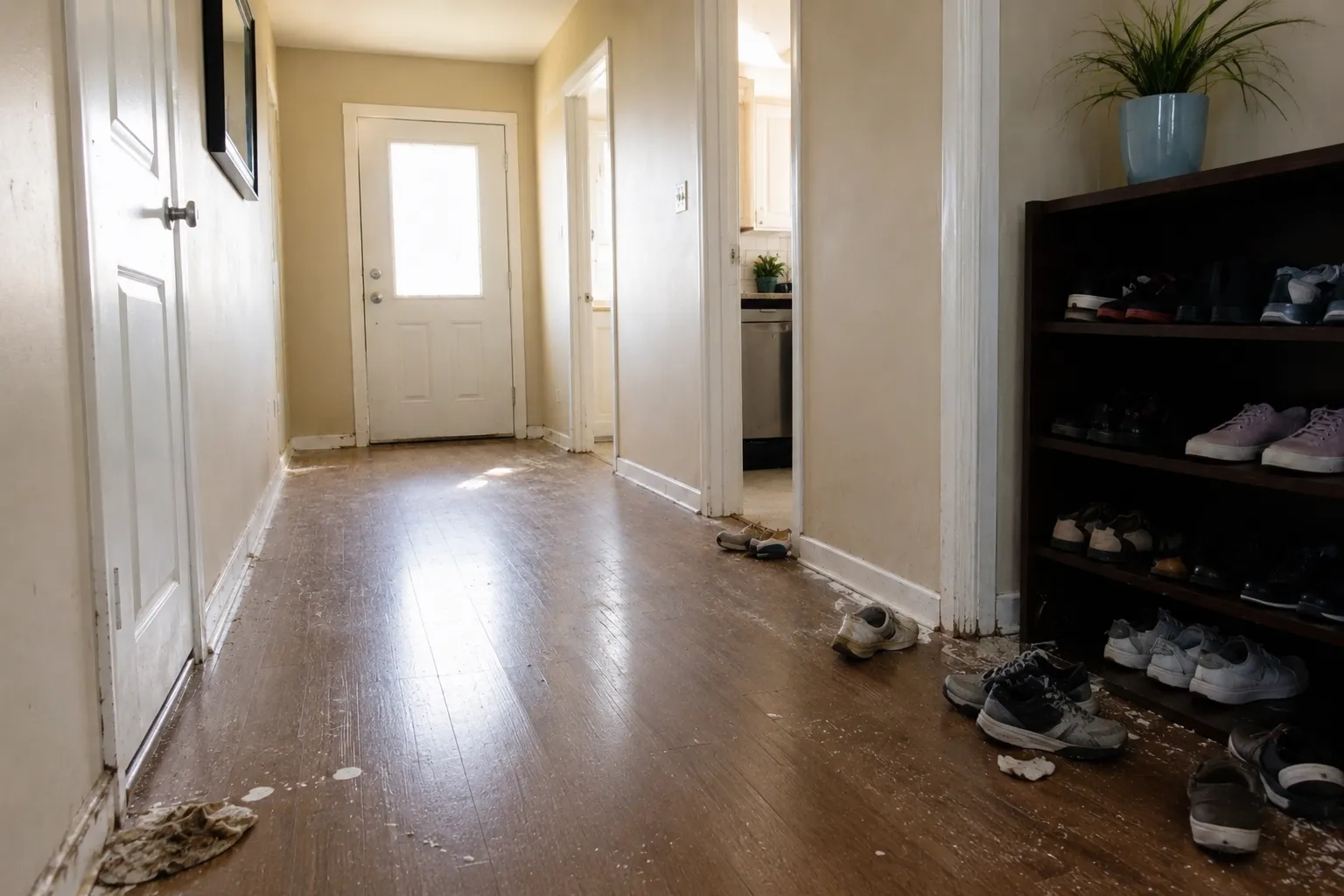
How Post-Renovation Cleaning Differs from Deep Cleaning
Many clients confuse these two types of cleaning, expecting the same result from a deep clean after a renovation — and end up with dusty corners and cement film. The difference is not in the volume of work, but in fundamentally different tasks and methods. Our practice in Almaty shows: construction cleaning requires specialized tools and chemicals that are not used in regular cleaning — and vice versa.
Construction Dust vs. Household Dust: Different Nature of Contaminants
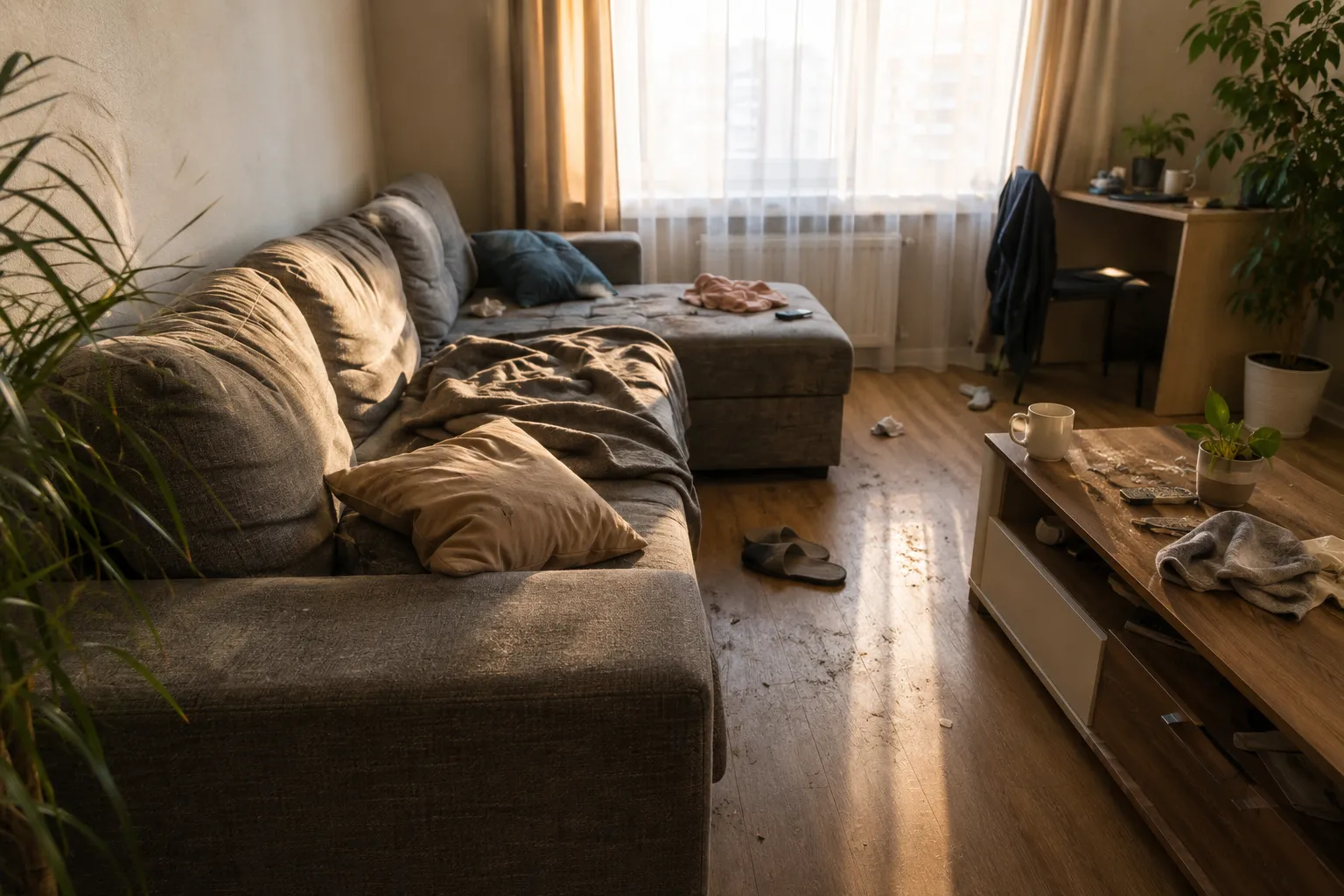
Household dust consists of micro-particles of skin, textiles, and street dirt. Construction dust is a suspension of cement, gypsum, putty, and silica chips that settle on surfaces as a film and harden under the influence of moisture. If you clean construction dust with a standard wet mop, the cement particles soften, spread, and embed into porous surfaces — laminate, unglazed tiles, untreated wood. We had a case: a client ordered a deep clean after painting walls, but gypsum streaks remained on the kitchen countertop — they had to be removed mechanically, risking damage to the coating. The difference is that construction contaminants are chemically active: cement hardens, gypsum swells, and mounting foam dissolves only with specialized removers. Therefore, before wet cleaning a construction site, a dry stage is mandatory — a vacuum cleaner with a HEPA filter captures 99.97% of particles up to 0.3 microns, preventing them from turning into an abrasive suspension.
Tools and Chemicals: What Works on a Construction Site vs. at Home
Deep cleaning uses universal detergents, microfiber mops, and a standard vacuum cleaner. At profi-clean, we use different equipment for construction sites: industrial vacuum cleaners class L or M with bags for fine dust, scrapers with carbide-tungsten coating for cement drips, steam cleaners with steam temperatures up to 160 °C to soften construction glue and sealant. The chemicals are also different: for removing silicone and mounting foam, we use aerosol removers based on D-limonene; for cement stains, acid-based compounds with orthophosphoric acid, which are safe for porcelain stoneware but aggressive for marble. Our cleaners undergo separate training to identify the type of contamination — whether it’s gypsum, cement, plaster, or paint — and select the product without testing on an inconspicuous area. In my opinion, the main mistake when doing post-renovation cleaning yourself is using household chemicals like “Universal” on cement streaks: they don’t remove it, only smear it, creating a matte film that then requires sanding.
Risks and Safety: Why You Shouldn’t Do Construction Cleaning Yourself
Household dust irritates mucous membranes, but construction dust contains crystalline silicon dioxide (quartz), which, when inhaled, settles in the lungs and over time causes silicosis. In Almaty apartments after wall sanding, the concentration of such dust in the air exceeds the maximum permissible concentration by 10–15 times during the first two hours after work. A standard household vacuum cleaner passes these particles back through the filter into the room — a HEPA filter class H13 retains 99.95%, and the bag of an industrial vacuum cleaner hermetically isolates the waste. Additionally, when washing windows after a renovation, the construction film on the glass often contains abrasive particles — if you wipe with a regular cloth, scratches appear. In our practice, there was a case: the owner of an apartment in the “Aksai” residential complex tried to clean dried paint splatters from plastic windows with a household cleaner — as a result, they damaged the profile lamination. Removing paint from PVC requires a specialized compound based on isopropyl alcohol, which does not corrode plastic. Before ordering a post-renovation cleaning, be sure to check with the company whether their cleaners are certified to work with construction contaminants — this directly affects the preservation of your finishing materials.
Timeframes: When Construction Cleaning is Effective and When It’s Pointless
General cleaning can be done at any time — it is not tied to the condition of surfaces. Construction cleaning is time-critical: cement splatters and putty must be removed within 24–48 hours after setting, before they achieve full hardness. If more than a week has passed, the cement crystallizes within the tile structure and can only be removed by mechanical grinding — risking damage to the glaze. Polyurethane foam sets in 6–12 hours; after that, it can only be cut off with a blade, leaving scratches on the surface. In Almaty, where air humidity during the heating season drops to 20–30%, construction mixtures dry faster — cement sets in 12–18 hours instead of the standard 24. Therefore, in our orders, we arrive on-site within 24 hours after the completion of construction work: this is the optimal window when most contaminants are still amenable to chemical removal without abrasives. Moreover, if self-leveling floors were used on the site, their final coating requires cleaning before setting — dust settling on the wet self-leveler becomes permanently fused into the surface, creating roughness that cannot be removed without re-sanding the entire floor.
What Contaminants Are Found on Construction Sites
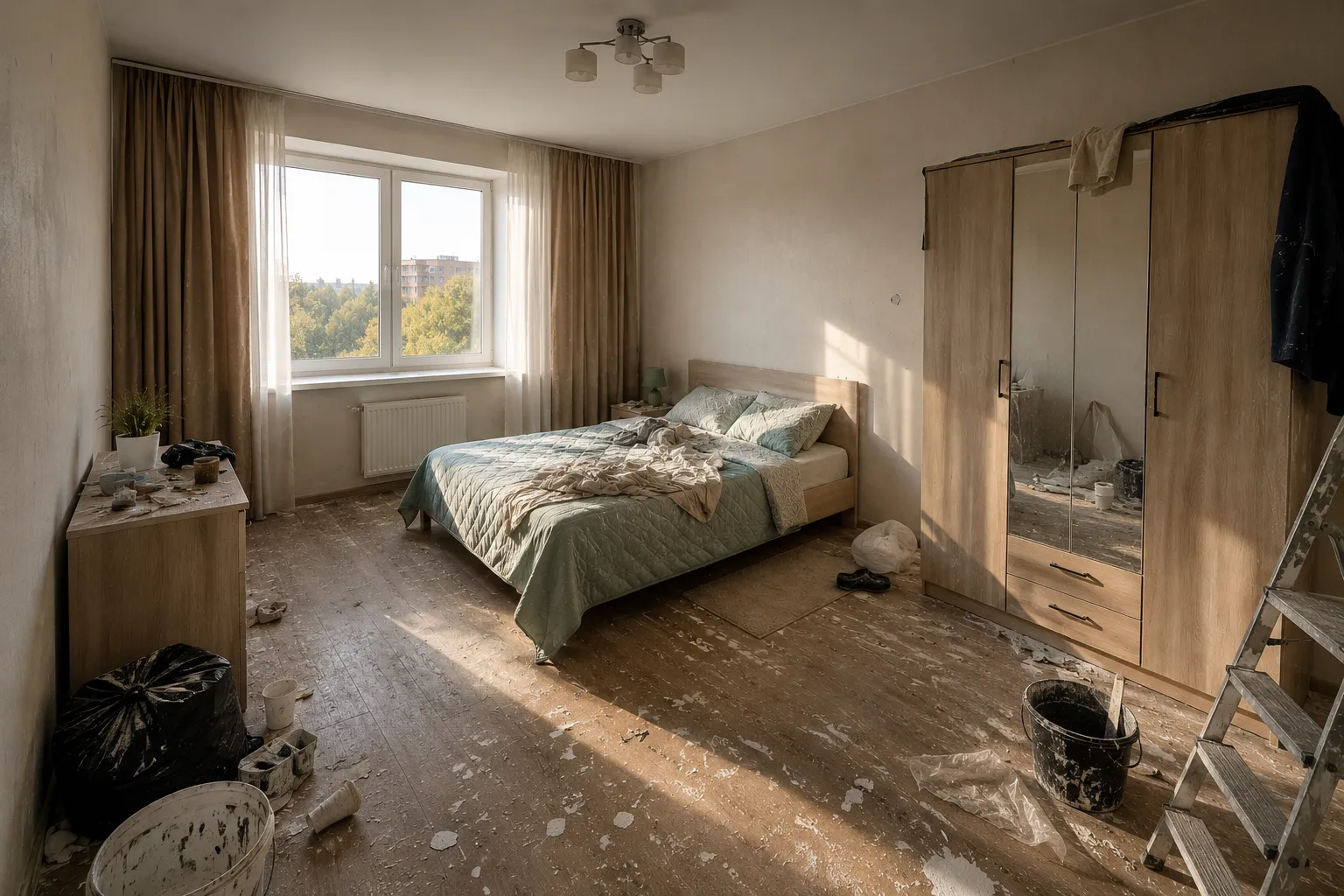
Each stage of renovation leaves its own type of contamination, and their combination determines the complexity of the cleaning. We distinguish five main categories, each requiring a specific approach and chemicals.
Construction Dust — Ubiquitous and Multi-Component
This is not just a gray haze, but a mixture of microparticles of concrete, plaster, putty, drywall, and wood. The dust fraction after wall chasing ranges from 0.1 to 10 microns; it settles on horizontal surfaces in a layer up to 2 mm thick just an hour after using a hammer drill. A regular vacuum cleaner with a dust bag allows up to 30% of such particles back into the air — which is why we use industrial units with an H13 HEPA filter, capturing 99.95% of particles. In practice, this means that after our cleaning, there is no residue left on windowsills and shelves that “dusts” for another week. A mistake those who try to clean dust with a wet cloth immediately make: water turns the fine fraction into mud that smears across surfaces — dry vacuuming is needed first.
Cement Splatters, Grout, and Adhesive — Hardened Chemicals
Cement mortar that gets on tiles, laminate, or double-glazed windows dries in 15-20 minutes, forming a hard-to-dissolve crust. Removing it mechanically (with a scraper) is risky: it leaves scratches on glossy tiles and chips on the protective layer of laminate. We use acid-based removers with orthophosphoric acid, which soften the cement stone in 3-5 minutes without damaging the base. Grout for joints on matte tiles is particularly insidious — if not washed off within a day, it penetrates the pores, and the white film can only be removed by sanding. In our practice at sites in Almaty, where tiles were laid in the new “Akbulak” residential complex, we encountered grout that had been left for three days — we had to treat each tile with remover manually, increasing cleaning time by 40%.
Paint Contaminants and Paint Aerosols
Paint that gets on wooden doors, architraves, or radiators is the second most common type of contamination after dust. Water-based paint washes off with warm water if no more than 4 hours have passed, but acrylic and alkyd compounds require solvents (white spirit, acetone). The difficulty is that painter’s tape does not always protect joints — paint seeps under it on the corners of slopes, and after drying, forms “drips” that need to be cut off with a blade at a 45-degree angle. Paint aerosol from a spray gun settles on all surfaces within a 3-4 meter radius of the painting area — on double-glazed windows, windowsills, even on textiles. We remove such film with special degreasers that leave no streaks and do not cloud the glass. During DIY cleaning, people often rub such stains with abrasive sponges — and end up with matte spots on glossy surfaces.
Polyurethane Foam, Sealants, and Silicone — Elastic Waste
Dried mounting foam is one of the most labor-intensive contaminants. It expands upon contact with air, filling gaps, but excess foam protrudes beyond the edges of the opening and hardens into a solid yellow mass. Fresh foam (before hardening) can be washed off with acetone or a special cleaner, but hardened foam must be cut off with a blade, and the residue ground down with a sander. Silicone sealants on bathtubs and kitchen backsplashes are removed mechanically, but leave a greasy residue that regular household chemicals cannot handle — a silicone remover is needed. In older housing stock in Almaty (Khrushchev-era buildings on Abay Avenue), we found layers of sealant applied over previous ones — we had to remove up to three layers to prepare the surface for cosmetic repairs.
Grease, Soot, and Oil Stains from Construction Equipment
On sites where welding work or metal cutting was performed, oily aerosols and soot are added to the construction dust. They settle on walls and ceilings as a greasy film, which attracts dust and forms a sticky coating. Regular detergents cannot handle it — an alkaline concentrate with a pH of 11-12 is needed, which breaks down grease at the molecular level. In new buildings with central heating, traces of fuel oil from welding on pipelines are often found — we treat such stains with emulsifiers to avoid damaging the radiators. If the greasy film is left unremoved, it will turn yellow and become embedded in the paint within a month — the walls will need to be repainted.
5 Common Mistakes When Cleaning Up After Renovations Yourself
Even after a careful renovation, construction dust, cement film, and adhesive drips remain, which household vacuum cleaners and household chemicals cannot handle. Here are five typical mistakes that turn cleaning into damaging the final finish.
Mistake 1: Washing Windows Before Removing Cement Dust
Many people start by washing the glass first, only to later notice scratches from abrasive particles that have become embedded in the PVC frame or aluminum profile. Cement dust is a suspension of quartz sand and silicates, which turns into an abrasive paste upon contact with water. If you wipe the glass with a damp cloth without first blowing off this suspension, the sand grains will leave micro-scratches, visible in side light. At profi-clean, on construction sites, we first blow out all horizontal surfaces with a compressor equipped with a HEPA filter, then sweep away the dry dust, and only then begin wet cleaning. We move on to windows last — after the walls and floor have already been dedusted. Before washing windows, ask the foreman for a diagram of the ventilation valve locations — dust gets sucked back into the room through them, rendering all the work useless.
Mistake 2: Using Household Cleaning Products on Construction Grime
A regular kitchen or bathroom cleaner does not dissolve hardened cement, mounting foam, or silicone sealant; it only smears them across the surface. The alkaline compositions of household gels (pH 8–9) are powerless against mineral deposits — acidic cleaners based on orthophosphoric or formic acid are needed. For example, cement splashes on porcelain stoneware can only be removed with an acidic concentrate, left on for 3–5 minutes, and then rinsed off with distilled water. In our practice, the most common case is when a client poured vinegar or lemon juice on a cement stain on laminate, which ate through the protective layer and left a matte spot. Each surface — porcelain stoneware, natural stone, laminate, painted walls — requires its own type of cleaner, and they cannot be mixed. Before picking up a spray bottle, test the product’s reaction on an inconspicuous area behind the baseboard — if matting appears within 30 seconds, this is not your cleaner.
Mistake 3: Trying to Collect Construction Dust with a Household Vacuum Cleaner
A household vacuum cleaner with a bag or container releases up to 30% of the finest particles (1–10 microns in size) back into the air, and its filter clogs with gypsum and plaster dust within 10–15 minutes of operation. Construction dust contains particles of gypsum, cement, quartz, and polymer additives — they settle in the lungs and cause allergies, while an H13 class HEPA filter traps 99.97% of such particles. On our sites, we use industrial vacuum cleaners with dust class L or M and disposable bags that are sealed before disposal. If you collect dust with a household appliance, a gray coating will reappear on windowsills and shelves a week after cleaning — this is the settled suspension that the vacuum expelled back into the air. Renting a construction vacuum cleaner for a day costs comparable to one cleaner visit, but after self-cleaning with a household appliance, you will have to wet-wipe all surfaces again.
Mistake 4: removing hardened mounting foam and silicone mechanically
Silicone and mounting foam are often scraped off with a spatula or blade, leaving deep scratches on tiles, laminate, or painted walls that cannot be hidden. Hardened mounting foam is a polyurethane polymer that is mechanically stronger than many finishing coatings: attempting to pry it off varnished parquet will certainly remove the varnish layer. The correct method is chemical softening with a special mounting foam remover (Dali, Soudal PU Remover) with a dwell time of 15–20 minutes, after which the residue is removed with a plastic scraper without force. Silicone sealant is removed with a silicone remover in 5–10 minutes, not with a spatula. If you have already scratched the surface, do not try to sand it with sandpaper — each material has its own restoration method: polishing for porcelain stoneware, wax for laminate, repainting for walls. At profi-clean sites, we always test the remover on a hidden area first because some acrylic paints react with solvents and blister.
Mistake 5: ignoring ventilation and air filtration during cleaning
Closed windows and switched-off supply ventilation cause suspended dust to settle back within 2–3 hours after cleaning, nullifying the result. During wet cleaning without fresh air supply, humidity rises to 80–90%, dust particles do not dry but stick to surfaces, forming streaks after drying. On our sites, we use dehumidifiers and construction fans that create a directed airflow from windows to the door — this removes the suspension outside in 30–40 minutes. If air conditioners are already installed in the room, their indoor units must be covered with film, otherwise dust will settle on the evaporator and then be distributed throughout the rooms every time they are turned on. After finishing cleaning, do not close the windows for at least 2 hours — let the residual suspension escape, otherwise the next day you will find a gray coating on all horizontal surfaces.
Why you should trust cleaning to profi-clean professionals
Even with a perfect renovation, construction dust remains in micro-cracks, and the cement film penetrates the tiles within the first hours — we explain why profi-clean staff cleaners handle this better than self-cleaning or hired teams without specialization.
The scale of post-construction dirt exceeds household capabilities
A construction site leaves up to 5–7 kg of dust per 50 sq. m of area — this is not light household suspension, but a heavy fraction with particles of cement, gypsum, quartz, and silicon. A regular vacuum cleaner with a paper bag clogs within 15 minutes of operation, and its filter lets the finest 0.3–1 micron particles back into the air. profi-clean uses industrial vacuum cleaners with H13/H14 class HEPA filters that trap 99.97% of particles up to 0.3 microns, including silicon and asbestos-containing dust — such equipment cannot be bought in a household store; renting it from suppliers in Almaty costs a significant amount per shift. During self-cleaning with a wet cloth, dust is smeared over surfaces, clogging the pores of laminate and micro-cracks in tile joints, which manifests as gray streaks after a month.
Chemical mistakes ruin coatings irreversibly
Cleaning cement splatters, adhesive runs, and mounting foam requires acidic or alkaline solutions — and choosing the wrong product can destroy the finish coating in a minute. On marble tiles and granite, you cannot use hydrochloric acid (it eats away the polish); for porcelain stoneware, formulations with a pH of 2–3 are needed; and for removing silicone from acrylic panels, only solvents without acetone are suitable. profi-clean cleaners undergo training on surface types: we have a material map for each property, and we apply a test patch in an inconspicuous area before treatment. In Almaty’s economy-class new buildings, cheap 21–22 class laminate flooring is often installed, which is afraid of wet cleaning — our specialists use microfiber with a spin-dry to 5% moisture and special polishes that protect the joints from delamination.
Hypoallergenic chemicals are safe for residents
Standard construction cleaners contain chlorine, ammonia, and phosphates, which remain on surfaces as a microscopic film and evaporate into the air for up to 72 hours after cleaning. In a sealed apartment after renovation, the concentration of volatile compounds can exceed the maximum permissible concentration by 3–5 times — this causes headaches, allergies, and respiratory tract irritation for residents, especially children and asthmatics. profi-clean uses certified water-based products from Kiehl (Germany) and Sodasan (Austria) with a pH of 5–8 — they break down into oxygen and water within 6–12 hours, leaving no film. For Almaty apartments with supply ventilation, which is often clogged with construction debris, we additionally wash all ventilation grilles and filters — otherwise, dust from the system returns to the rooms within a day.
Professional equipment for hard-to-reach areas
After renovation, double-glazed windows are covered with a film from mounting foam, paint splatters, and cement suspension — washing them manually with a rag and detergent is useless: streaks remain, and the film is removed unevenly. We have a dual-circuit window washing machine with distilled water and a telescopic pole up to 8 meters, which removes dirt without streaks in a single pass. Baseboards, interior doors, and heating radiators are areas where construction dust accumulates in a layer of up to 3–5 mm, and blowing it out with a hairdryer or sweeping it with a broom is impossible without it resettling. profi-clean uses steam cleaners with steam temperatures up to 150 °C, which soften the cement film and glue on baseboards and pull dirt out of joints without damaging the paintwork. In Almaty apartments with panoramic glazing (residential complexes “Nurly Tau”, “Akbulak”, “Triumph”), window heights reach 2.7–3 meters — our poles allow washing them from the floor without ladders or risk of falling.
Time savings and result guarantee
Self-cleaning after renovation in a one-bedroom apartment of 40–50 sq. m takes 3–4 days for two people — with half the time spent scrubbing cement splatters and re-washing windows. profi-clean dispatches a team of 3–4 cleaners and completes the property in 4–6 hours, including washing windows, range hoods, and radiators. We offer a 24-hour guarantee on the result: if you notice a missed area after our cleaning, we return and redo it for free, without additional approval. In Almaty, there are many properties with basement floors and cellar rooms (private houses in the villages of “Kokkaynar”, “Algabas”), where an oily film from tools and bitumen stains remain after construction — our formulations handle them in one go, while without experience, such cleaning takes a week.
Checklist: when self-cleaning won’t work
- Cement splatters on porcelain stoneware: without an acidic cleaner, they won’t come off, and mechanical scraping with a spatula scratches the glaze — you need a chemical with a pH of 2–3 and a dwell time of 3–5 minutes.
- Mounting foam on double-glazed windows: acetone-containing products corrode the seal, and mechanical removal leaves scratches — we use special polyurethane removers.
- Adhesive film on laminate flooring: wet cleaning spreads the glue across the surface, and it darkens within a month — an alcohol-based solution and microfiber with minimal moisture are needed.
- Dust in ventilation ducts: a regular vacuum cleaner cannot reach the bends, and dust returns to the rooms within 2–3 days — we use crevice tools and wash the grilles.
- Oil stains on concrete floors: household chemicals do not break down technical oil — we use emulsifiers with a pH of 10–12 and a mechanical brush on a rotary machine.
Features of Construction Site Cleaning in Almaty
Post-renovation cleaning in Almaty has its own specifics: a climate with sharp humidity fluctuations, dusty air, and the characteristics of local building materials create contaminants that cannot be removed with ordinary household chemicals. Let’s break down the key nuances that affect the result.
The Impact of Almaty’s Climate on Construction Contaminants
Air humidity in Almaty ranges from 25% on dry summer days to 80% during the rainy off-season — this directly affects the setting time of cement mixtures. At humidity levels above 60%, the cement film on tiles sets in 4-6 hours instead of the usual 12-24, embedding into the pores of porcelain stoneware. In dry weather, construction dust settles not on the floor, but on vertical surfaces — cabinets, walls, double-glazed windows — due to static electricity generated by dry air. At profi-clean, we use a hygrometer before starting work: if the indoor humidity is below 40%, we first treat surfaces with an antistatic agent to prevent dust from scattering again during washing. At sites in the Nauryzbai district, where the proximity of the mountains results in higher humidity, we remove cement contaminants mechanically rather than chemically — acid in such conditions erodes grout faster.
Specifics of Building Materials on the Almaty Market
Construction sites in Almaty actively use dry mixes from local manufacturers — “KazCement”, “Silikat”, “AlmatyKurylysMaterialdary” — which differ in composition from Russian or European counterparts. “KazCement” has a 5-7% higher proportion of clay impurities, resulting in a stickier cement film that is difficult to remove with acid washes. “Hercules” tile adhesive, produced in Kazakhstan, contains more polymer additives — after setting, it forms not just a film but a glassy layer that can only be removed with a mechanical scraper fitted with a carbide blade. “StroyPena” mounting foam from Kazakhstan has a lower density (18-20 kg/m³ versus the standard 22-25), causing it to crumble rather than cut evenly, leaving microparticles that clog into micro-cracks in laminate flooring. At sites with this type of foam, we use an industrial vacuum cleaner with an H13 class HEPA filter — only this can capture particles down to 0.3 microns; otherwise, they will reappear on the surface as a white coating within a month.
Why “General Cleaning” Doesn’t Work After Renovation
Standard general cleaning is designed for household contaminants — grease, dust, pet hair — and uses neutral detergents with a pH of 6-8. Construction contaminants require alkaline compounds (pH 10-12 for cement) or acidic ones (pH 2-4 for lime scale), as well as mechanical action. In Almaty, this difference is critical: the tap water here is hard (7-8 mg-eq/L), and when mixed with household detergents, it forms insoluble calcium salts that leave white streaks on tiles — which then have to be removed separately. At one site in the “Akbulak” residential complex, the client had general cleaning done twice by a neighboring building’s cleaning service — the result was zero until we arrived with the professional Kiehl product line: an alkaline concentrate for cement, an acidic one for grout, and a final neutralizer to remove chemical residues. The difference in work hours was 3 hours for us versus 12 hours for the two previous teams.
Risks to Surfaces from Improper Cleaning
Incorrectly chosen chemicals or tools can irreparably damage finishes, and in Almaty, this happens more often due to a shortage of quality materials on the market. A stretch ceiling from the Kazakh manufacturer “PotolokMaster” has a thinner PVC film (0.15 mm versus 0.20-0.25 mm for European brands), and attempting to wipe off construction dust with a damp cloth can