How Cleaning a Toilet Differs from Cleaning a Bathroom
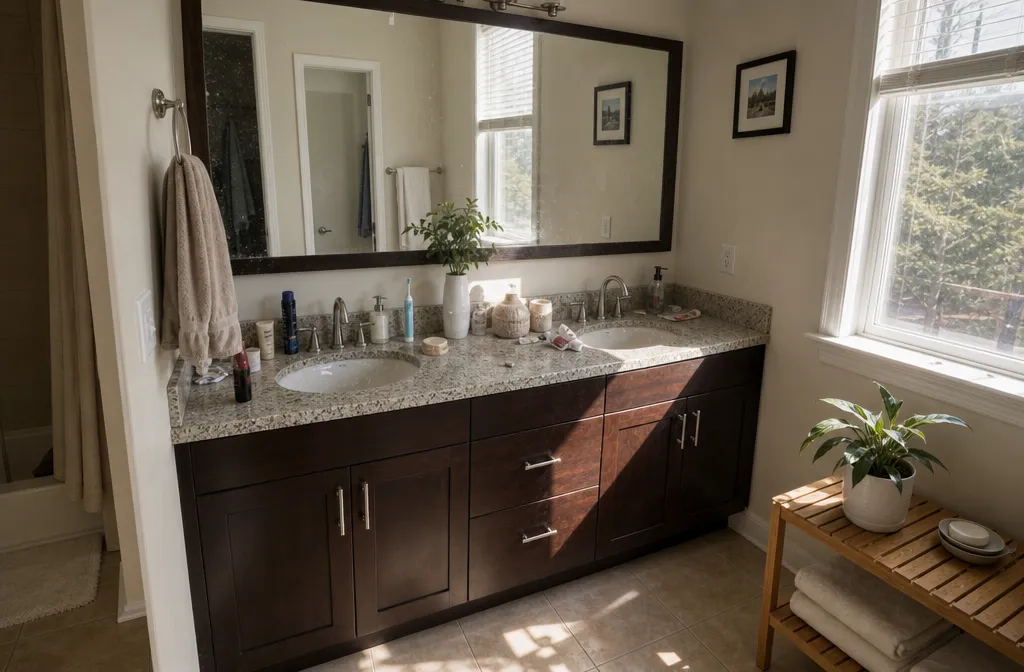
Many people order “bathroom cleaning” and receive standard treatment of the sink, toilet, and shower cabin — but a separate toilet room requires a fundamentally different approach. In practice, the difference between these two objects lies in the biological load, finishing materials, and disinfection protocols. Our profi-clean team encounters daily that clients confuse these services, and then are surprised why the smell doesn’t go away or the plaque returns within a week. We’ll explain exactly how cleaning a toilet differs from cleaning a bathroom — and why this is not just a matter of terminology.
Biological Load and Risk Zones
The main difference: in a separate toilet room, the biological load on surfaces is 3-4 times higher than in a combined bathroom, due to the lack of constant water flow and ventilation. In a bathroom, the shower cabin and sink daily wash away part of the contaminants with water, while the toilet in a separate room is the only source of moisture, creating an ideal environment for bacteria. In our practice in Almaty, we record that in separate toilets, the concentration of E. coli on the walls behind the toilet and at the junction of the floor with the baseboard is 2-3 times higher than in bathrooms with a shower. Therefore, cleaning a toilet requires mandatory treatment not only of visible areas but also of hard-to-reach places: behind the installation, under the toilet rim, around the flush tank. Before starting cleaning, always check the condition of silicone seams and tile joints — if they are damaged, disinfection will not have a long-term effect, and the smell will return within 5-7 days.
Finishing Materials: Tile vs. Paint and Plastic
A typical mistake: using the same products in a toilet as in a bathroom with a shower — aggressive chemicals for tiles destroy plastic panels and matte paint on the walls. In combined bathrooms in Almaty, tile with grout, resistant to acids and alkalis, is more common, while in separate toilets, moisture-resistant paint, plastic panels, and stretch ceilings are used. For example, in new buildings of the “Moscow” and “Triumphalny” residential complexes, the toilet walls are painted with Dulux matte paint: even a weak chlorine bleach solution leaves whitish streaks on it that cannot be washed off. For such surfaces, we use only neutral pH products from Kiehl (UltraClean series) with an exposure of 5-7 minutes — they remove the biofilm without damaging the coating. If your toilet walls are painted or finished with plastic, never use abrasive pastes or products with a chlorine content above 3% — the matte surface will become glossy and start collecting contaminants 2 times faster.
Ventilation and Condensation: The Hidden Threat
The main problem with separate toilets: they have almost no natural ventilation, and forced exhaust often works through the kitchen, creating a stagnant zone of humid air. In bathrooms with a shower, excess steam escapes through ventilation naturally — in a separate toilet without a shower, moisture from flushing and condensation on cold pipes remain on surfaces. In Almaty apartments of standard series (residential complexes “Altyn Orda”, “Samal-3”), the toilet ventilation duct is combined with the kitchen one: when the kitchen hood is working, reverse draft forms in the toilet, and odors are not removed. Cleaning a toilet in such conditions should include not only washing but also drying surfaces — we always wipe cold water pipes dry with microfiber and treat them with an anti-condensation spray. After cleaning, leave the toilet door open for 30 minutes — this reduces humidity by 15-20% and prevents the appearance of black mold at the junction of the ceiling and wall.
Disinfection Protocol: Difference in Concentrations
A toilet requires a more aggressive disinfection protocol: the concentration of active chlorine or oxygen should be 1.5-2 times higher than in a bathroom, especially on the toilet and the floor around it. In a bathroom with a shower, treatment with a standard product with a dwell time of 3-5 minutes is sufficient — water washes away the chemical residues. In a separate toilet without wet cleaning from a shower, bacteria accumulate on the floor and lower part of the walls. At profi-clean, we use a three-stage protocol: first, an alkaline compound to soften urine scale and biofilm (exposure 7-10 minutes), then an acidic cleaner to remove mineral deposits (3-5 minutes), and final disinfection with an oxygen-based product Sodasan with a dwell time of 10-15 minutes. Never mix alkaline and acidic products — this neutralizes both compounds; between stages, be sure to rinse the surface with clean water.
How to Remove Stubborn Limescale in a Toilet
You won’t get rid of stubborn limescale with regular household chemicals alone — you need an acid protocol with precise timing and mechanical action, otherwise the limescale layer will remain under the glaze. In profi-clean’s practice, we have a proven scheme for such cases.
Why Regular Gels Don’t Work on Stubborn Limescale
Alkaline products (Cif, Domestos, Comet) are effective against grease and organic matter, but calcium carbonate — the basis of limescale — only dissolves in acid with a pH below 3. Gels for rust and scale with citric or formic acid work on fresh deposits, but on a layer 2-4 mm thick, they only soften the top film. We at profi-clean recall a case: a client poured “Toilet Duck” into the toilet for six months; the limescale only hardened and darkened — we had to remove it with a professional orthophosphoric acid concentrate in two passes. Alkali is useless on old limescale, and mass-market acid gel only works with repeated application, a 20-30 minute pause, and mandatory mechanical scrubbing with a stiff brush.
Tools and Chemicals for Professional Removal in Almaty
To work with stubborn limescale, profi-clean uses a concentrate based on 15-20% orthophosphoric acid (e.g., “Sifon” from the Kazakh brand “Airat” or Cillit Bang anti-scale in a boosted dose) — it softens the limescale layer in 10-15 minutes. For mechanical action, we use a polymer abrasive sponge (not a metal one, as it scratches the earthenware) and a medium-stiffness brush. For hard-to-reach areas under the rim — a flexible drill attachment with nylon bristles, which profi-clean purchases from the Kaspi Store for an individually calculated amount. Rubber gloves are mandatory — the acid burns the skin — and a respirator is needed if the bathroom ventilation is poor. Before applying acid, we always drain the water from the toilet bowl completely: water dilutes the concentrate and reduces its effectiveness.
profi-clean’s Step-by-Step Protocol for Stubborn Limescale
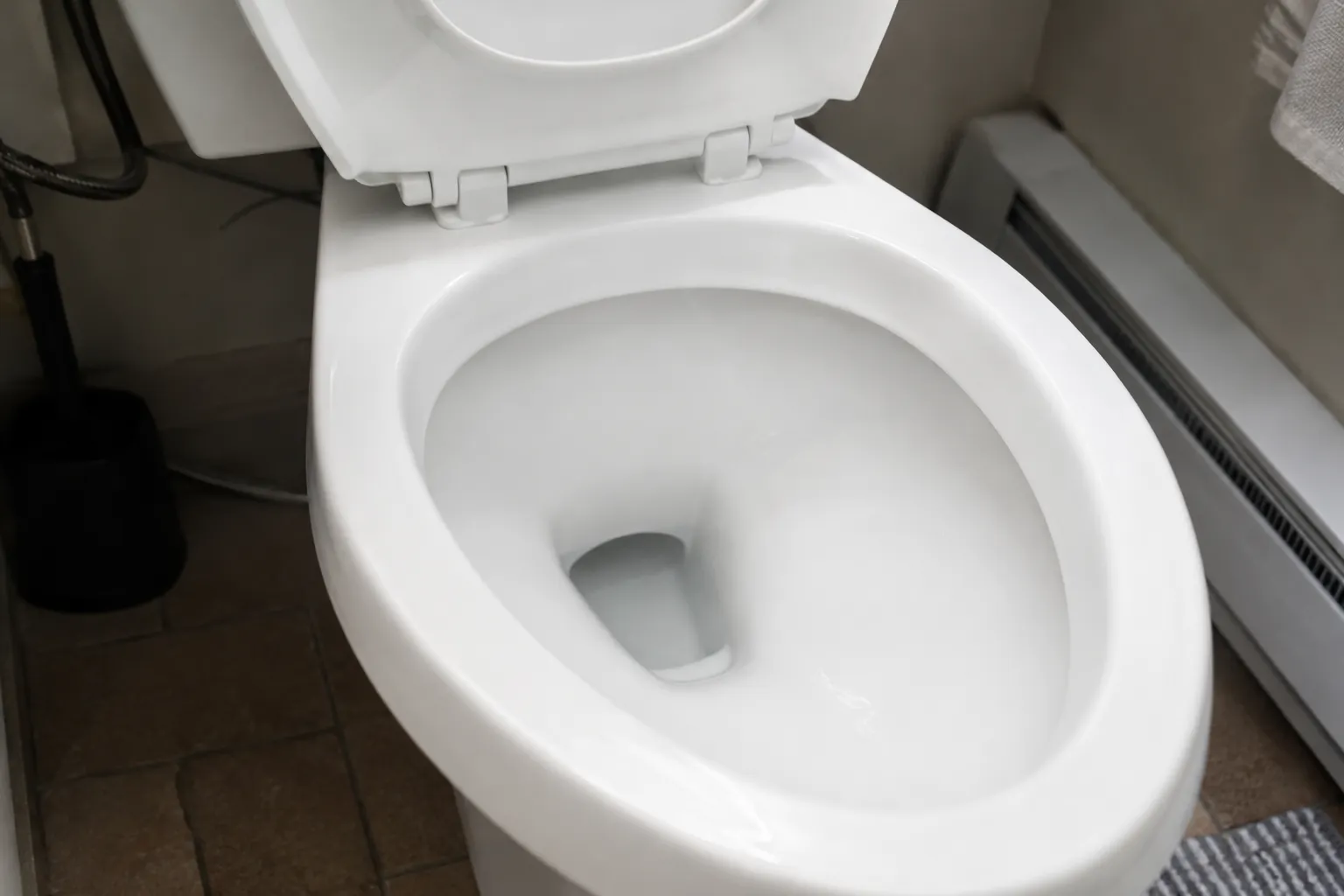
First, we drain the water and dry the bowl with paper towels — moisture prevents the acid from adhering to the limescale. Then, we apply the orthophosphoric acid concentrate with a sponge or brush (don’t pour it in — the acid is aggressive to rubber seals) and leave it for 12-15 minutes. After softening, we mechanically clean with a polymer sponge using circular motions without strong pressure to avoid wearing away the glaze. If the limescale doesn’t come off the first time, we repeat the application for another 10 minutes. Finally, we rinse thoroughly with water (2-3 flushes) and neutralize the acid with a soda solution (2 tablespoons of soda per 1 liter of water). For particularly dense layers (over 3 mm), profi-clean uses a paste of citric acid and water in a 3:1 ratio — it’s applied for 30 minutes under plastic wrap to slow down drying.
Common Mistakes When Removing Limescale in Almaty Water Conditions
In Almaty, the water is hard (5-7 mg-eq/L in carbonate hardness) — limescale builds up faster than in Astana, and its layers contain iron impurities from old pipes. Mistake one: trying to scrape off limescale with a knife or metal brush — this leaves micro-scratches on the earthenware, where dirt gets embedded, and the toilet darkens. Mistake two: using acid without draining the water — the diluted solution doesn’t reach the required concentration, and the limescale remains. Mistake three: not neutralizing the acid after cleaning — acid residues corrode the rubber drain seal, leading to a leak within 2-3 months. In profi-clean’s practice, there was a call to the “Akbulak” residential complex — a client poured “Krot” on the limescale, waited an hour, and flushed; the limescale didn’t come off, and the enamel dulled. We had to remove the layer with an acid protocol and finish with a polishing polish for earthenware.
When Limescale Can’t Be Removed — Toilet Replacement Needed
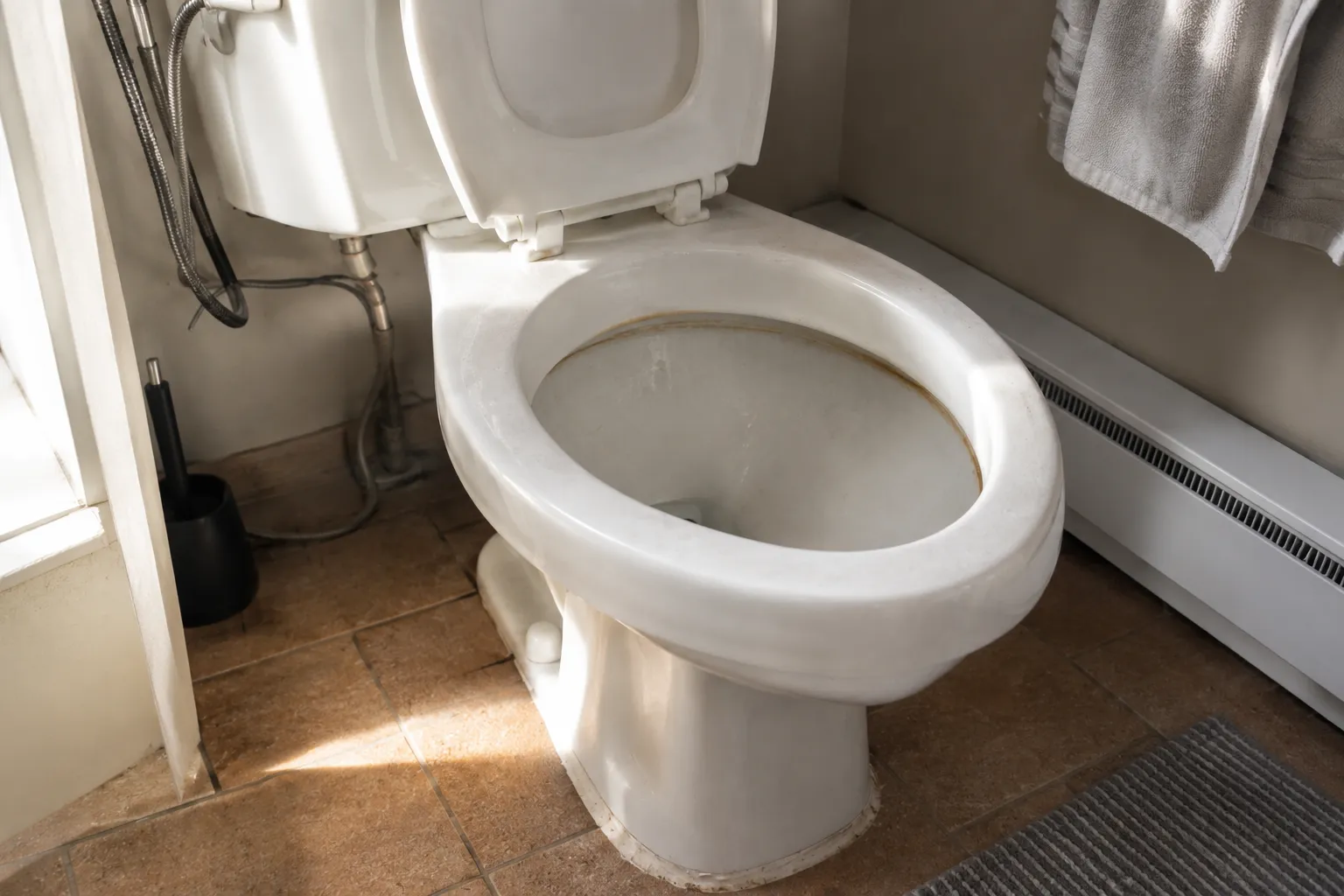
If the limescale layer is older than 3-4 years and its thickness exceeds 5 mm, salt deposits may have grown into micro-cracks in the glaze — acid cleaning will remove the top layer, but the toilet will remain rough and will get dirty faster. In such cases, profi-clean recommends replacement: the cost of a new toilet in Almaty ranges from a significant amount (Cersanit, Sanita) to an even more significant one (Villeroy & Boch) against the risk that after cleaning, indelible stains will remain on the surface. Another sign is if, after the acid protocol, the water in the toilet does not drain as a smooth film but collects in droplets: the glaze is destroyed, and it is better to replace the toilet. Before acid cleaning on an old toilet, we check the surface for hidden chips — we pour water with potassium permanganate: if a pink spot appears on the outer wall after 10 minutes, the enamel is allowing moisture through, and cleaning will accelerate destruction.
Which Products Are Effective Against Urine Scale
Urine scale is not just plaque, but compressed mineral sediment (struvite + hydroxyapatite) that household chemicals cannot handle without the right acid and dwell time. At profi-clean, we encounter this problem daily in Almaty apartments and know which formulations actually work and which only mask the odor.
Acidic Products — The Foundation Against Mineral Deposits
Hydrochloric acid (HCl) 5–10%: the only reagent that dissolves struvite in 10–15 minutes without mechanical cleaning. We use it in industrial concentrations only with a respirator and gloves — it is dangerous for home use: fumes corrode mucous membranes, and contact with chlorine-containing products releases toxic chlorine. Oxalic acid: milder than HCl, but effective against hydroxyapatite with a dwell time of 30–40 minutes. It is included in professional Kiehl powders — it leaves no yellowness on earthenware. Citric acid (powder 50–100 g): a safe home option, but only works on fresh deposits (up to 2–3 weeks). Citric acid will not remove an old layer of 3–5 mm — oxalic or hydrochloric acid is needed. In our practice, there was a case where a client poured citric acid into the toilet overnight 10 times in a row — the deposit softened but did not come off; we had to go out with an acid protocol.
Alkaline Formulations — Against Organics and Odor
Sodium hypochlorite (bleach, Domestos): kills bacteria and softens the organic film that binds urine scale crystals. But the scale itself is not dissolved by alkali — this is a myth. We apply hypochlorite for 5 minutes as a preliminary step, then rinse and pour in acid. Enzyme cleaners (Sodasan, BioMio): break down urea and lipids at the molecular level, removing the “cat litter box smell” that chlorine cannot eliminate. For prevention once a week — effective, but useless against hard scale. Hydrogen peroxide 6%: an alternative to chlorine for allergy sufferers — oxidizes organics without a pungent odor, but the dwell time is 20–30 minutes, and only in combination with subsequent acid.
Abrasive Methods — When Chemicals Are Powerless
Pumice stone for toilets (special block): mechanically removes the top layer of scale if the deposit height is less than 2 mm. Important: pumice is used only when wet, otherwise scratches remain, into which new scale immediately embeds. Polishing paste (Frosch, Cif with microgranules): polishes earthenware after acid treatment — removes roughness on which scale grows faster. In Almaty water (hardness 7–8 °dH), without polishing, new crystallization points appear within a month. Ultrasonic scraper: our tool for hard-to-reach places — under the toilet rim and in the siphon. A frequency of 25–40 kHz breaks off scale that chemicals could not handle in 2–3 minutes without the risk of damaging the enamel.
Mistakes in Choosing Products — What Doesn’t Work
Laundry soap and baking soda: a popular folk method — but baking soda creates a weak alkaline environment (pH 9–10) that does not affect struvite, and soap leaves a greasy film that accelerates the re-formation of scale. Vinegar essence 70%: when heated, it releases caustic fumes, and without heating, its effectiveness is lower than citric acid. In Almaty high-rise buildings (Soviet-era risers), vinegar corrodes the rubber gaskets of the flush tank — then leaks occur. Chlorine-containing tablets for the tank (Bref, Chirton): do not remove already formed scale, only slow its growth — and even then, only if the tablet is changed every 2 weeks. With hard water at 7–8 °dH, the preventive dose of chlorine is too small to stop crystallization.
Specifics of Almaty Water — Why an Enhanced Protocol Is Needed
Tap water in Almaty comes from the Big Almaty Canal and spring sources, with a total hardness of 7–8 °dH (according to the State Enterprise “Holding Almaty Su”). This is higher than the Kazakhstan average (5–6 °dH), so uric scale in toilets forms 2–3 weeks faster than in Astana or Karaganda. In areas with artesian water admixture (Bostandyk, Medeu districts), hardness reaches 9 °dH — there we recommend acid treatment once a month instead of the standard two. If you live in a house built before 1990 (cast iron risers), iron and manganese salts settle inside the pipes — they mix with uric scale, forming a dense black-brown conglomerate that neither citric nor oxalic acid can handle without pre-soaking in hydrochloric acid. Our cleaners always take HCl 10% before going to such a house — it’s the only thing that breaks through the hybrid deposit in 20 minutes.
Toilet Cleaning Features in Almaty: Hard Water
Hard water from Almaty’s municipal networks is the key reason why toilet cleaning in the city requires a different approach than in regions with soft water. It leaves salt deposits that ordinary alkalis cannot dissolve, and within a year turns a clean toilet into a problem with plaque and scale.
How Water Hardness Affects the Rate of Plaque Formation
With Almaty water hardness at 5–7 mg-eq/L (data from “Almaty Su”), limescale on toilet bowl walls appears within 7–10 days after cleaning, not 3–4 weeks as in cities with soft water. Calcium and magnesium carbonates settle in the toilet bowl, forming a layer of 0.3–0.5 mm per month, and if not removed with acid, a crust forms after six months that cannot be removed mechanically. In our experience on jobs in the Medeu district, where water is harder due to mountain springs, plaque grows 20–25% faster than in the Bostandyk district. Therefore, the interval between deep toilet cleanings in Almaty should be 10–14 days, not once a month as general recommendations suggest.
Why Alkaline Chemicals Lose to Acids on Almaty Water
Alkaline products (bleach, “Domestos”, “Cillit Bang” with active chlorine) are effective against grease and organics, but they are powerless against the carbonate deposits caused by hard water — pH 11–12 does not dissolve calcium salts. We use acid-based preparations with sulfamic or oxalic acid (Kiehl K-29, Sodasan Sanitär-Reiniger) with a pH of 1.5–2.5 — they soften the carbonate layer in 5–7 minutes, after which the plaque is removed with a soft brush without abrasives. If a cleaner uses household alkali on Almaty water, they only mask the plaque — it will reappear after 2–3 flushes. Our recommendation: for weekly toilet cleaning, an acid spray with a 3-minute dwell time is sufficient, and for a one-time deep clean, a protocol with gel application for 10–15 minutes.
The Mistake of Using Abrasive Powders on Toilet Enamel
Hard water forces some clients to use “Pemolux” or soda to scrub off plaque — this is a gross mistake that destroys the enamel. Abrasive particles scratch the glaze, and hard water salts get lodged in the micro-cracks — after 6–8 months, the toilet begins to yellow unevenly, and it becomes impossible to clean without replacement. We tested this on toilets in Almaty apartments built in the 1970s–80s (Zharokova St., Samal-2 microdistrict): after 2–3 abrasive cleanings, the enamel loses 40–50% of its gloss, and acid cleaning stops working — the plaque embeds into the rough surface. At profi-clean, we use only liquid acid concentrates and microfiber with a density of 300–400 g/m² — they don’t scratch but dissolve deposits down to the factory shine.
How Hard Water Affects Rubber Seals and Fittings
Hard water salts settle not only on the toilet bowl but also on the rubber gaskets of the flush tank, seals, and float valve — within 12–18 months, they turn elastic rubber into a hard, crumbling mass. In Almaty, due to the high salt content in the water, gaskets fail 30–40% faster than in regions with soft water (data from profi-clean service reports over the year). During every toilet cleaning, we treat rubber elements with silicone lubricant (WD-40 Specialist) — this extends their lifespan to 2–3 years. If a cleaner ignores the fittings and only cleans the bowl, within a year the client will end up with a leaking tank and a musty smell, even if the toilet bowl plaque is clean.
Specifics of Almaty Risers and Salt-Related Clogs
In older residential buildings in Almaty (Center, Tastak, “Kazakhfilm” microdistrict), cast-iron sewer risers are coated internally with a 2–5 mm layer of salt deposits — this narrows the pipe’s diameter and accelerates clogs. When cleaning the toilet, we check the drain speed: if water takes 10–15 seconds to drain instead of 3-5, it means a “stalactite” of carbonates has grown on the inner pipe walls. Every 3-4 months, we recommend flushing the riser with an acidic solution (200 g citric acid per 5 liters of hot water, left for 2 hours) — this dissolves salt deposits and restores flow capacity to factory levels. In our practice, after such a flush in an apartment on Baitursynov Street, clogs stopped for a year and a half, even though the client had previously called a plumber every 2 months.
How often should you deep clean your toilet
The frequency of deep toilet cleaning depends not on the calendar, but on three factors: tap water hardness, number of residents, and type of plumbing. In Almaty, where water produces dense sediment within a week, the standard European norm of “once a month” doesn’t work — at profi-clean, we see that the optimal cycle for local conditions is 10-14 days for an average family of three.
Why monthly cleaning in Almaty is a mistake
With water hardness of 7-9 mg-eq/L (data from “Almaty Su”), calcium carbonate begins to crystallize on porcelain just 4-5 days after washing. By day 10, the deposit becomes visible to the naked eye, and by day 21, it turns into a dense crust that requires 2-3 passes of an acidic protocol instead of one. Our cleaners note: in apartments where deep toilet cleaning is ordered once a month, the volume of mechanical treatment for the toilet is 60-70% higher than with a two-week cycle. The difference in labor directly affects the final cost — the less frequent the cleaning, the longer and more difficult it is to restore the plumbing to its original state. With a monthly schedule, you lose not only time but also enamel integrity: aggressive acidic compounds thin the protective layer of porcelain by 0.1-0.3 microns per procedure with each contact.
Frequency scenarios for different household types
| Family composition |
Recommended interval |
Key risk if skipped |
| 1-2 people, apartment with soft water (city networks in southern Almaty) |
14-18 days |
Light deposit removed with alkaline cleaner, no acid needed |
| 3-4 people, standard apartment, hard water (northern areas, Alatau district) |
10-12 days |
By day 14, uric scale forms a primary crust on bowl walls |
| 5+ people, private house with well water (hardness 10+ mg-eq/L) |
7-8 days |
After 9 days, sediment becomes insoluble, requiring an acidic protocol |
| Family with a child under 3 (frequent flushes, hygiene treatments) |
10-12 days |
Residues from children’s hygiene products accelerate struvite formation by 25-30% |
How to know when to call cleaners — three objective markers
The first sign is a visual change in the porcelain surface: if after regular cleaning you run your finger along the inner wall of the toilet above the waterline and feel roughness, the deposit has already started crystallizing. The second marker is an odor from the drain hole after an overnight stand: an ammonia tint indicates urea decomposition in micro-cracks of the siphon that a brush can’t reach. The third is the appearance of a yellowish ring at the water level when hardness exceeds 6 mg-eq/L; this signals that carbonate sediment has cemented organic matter, and regular cleaning agents are powerless. For accurate self-diagnosis, drop a test strip for aquarium water (sold in pet stores for an individually calculated amount) into the tank — if total hardness is above 7 dGH, the interval between deep cleanings should be reduced to 10 days.
The “once a week” mistake — when frequent cleaning is harmful
Some profi-clean clients order a deep toilet cleaning weekly, believing that the more often, the cleaner. In practice, with a 5–7 day interval, acidic compounds do not have time to neutralize on the earthenware surface — residual acid reacts with the new product, creating an aggressive environment that strips the enamel’s gloss. After just 3–4 such cycles, matte spots appear on the toilet, especially in the water ring area. The optimal minimum between acidic treatments is 10 days, and in between, alkaline care without abrasives is sufficient. Before ordering your next cleaning, check which protocol was used last time — alternating acidic and alkaline cycles with a 10–14 day interval provides maximum cleanliness without damaging the plumbing fixtures.